This article contains advertising. Our booking links are routed through a partner that adds commission tracking automatically, so if you book through one we earn a commission from the provider, at no extra cost to you. It never affects what we recommend. Affiliate disclosure
You can stand in front of the Haçienda Apartments at 11/13 Whitworth Street West and look at a perfectly ordinary 2000s apartment block. There is one small blue plaque, easy to miss, mounted just left of the residents’ entrance. That’s it. Nothing else marks the site of what was, for fifteen years, the most internationally famous nightclub in the world — the building that hosted the Second Summer of Love in 1988-89, exported acid house from Chicago to Europe, broke the Stone Roses and the Happy Mondays, lost millions of pounds, was funded by Joy Division and New Order’s record sales, became the centre of a national gang-warfare crisis, and finally closed its doors in June 1997 before being demolished in 2002.
This is the full story of The Haçienda (FAC51) and Factory Records — the label that bankrolled it, the city that built it, and the musical legacy it left behind. It’s also a practical guide to what you can actually visit today: the plaque, the surviving Factory bar, the Hacienda Classical concert series that recreates the experience with an orchestra, and the modern Manchester venues that consciously carry the Haçienda’s spirit forward. By the end you’ll understand why this empty piece of Manchester real estate is one of the most-visited unmarked tourist sites in British music.

How Factory Records Began (1978)
Factory Records was founded in 1978 by Tony Wilson (a Granada TV presenter and music journalist), Alan Erasmus (an actor and Wilson’s collaborator), Rob Gretton (later Joy Division’s manager), and the producer Martin Hannett. The label was designed from the start as a cultural statement rather than a conventional music business — every release got a Factory catalogue number (FAC), and crucially these numbers extended to things that were not records at all. Tony Wilson’s own coffin was given the catalogue number FAC 501. A poster designed by Peter Saville was FAC 9. The Haçienda itself was FAC 51.
The first release — A Factory Sample, FAC 2 — was an EP featuring Joy Division, John Dowie, Cabaret Voltaire, and the Durutti Column. Joy Division’s Unknown Pleasures (FAC 10) followed in June 1979, packaged by Peter Saville with the now-iconic pulsar wave artwork that would become one of the most-copied album covers in music history. Factory’s design language under Saville — minimalist, typographic, often expensive to produce — defined post-punk visual identity globally for the next decade.
The label’s founding ethos was Tony Wilson’s: artists kept their masters, contracts were sometimes written on napkins (the legendary New Order contract was “written in Tony’s blood”), and the focus was on cultural impact rather than profit. This worked brilliantly for the music; it worked catastrophically for the accounts. Read more about the broader era in our Manchester music history article.
The Haçienda Opens — 21 May 1982
By 1981, Joy Division’s surviving members (now reformed as New Order) and Factory Records had enough commercial momentum to fund a permanent music venue. Tony Wilson and Rob Gretton wanted Manchester to have a club befitting the city’s musical reputation. They bought the lease on a former International Yacht Showroom at 11/13 Whitworth Street West — a cavernous warehouse-style building with a vast central floor space and high ceilings that had originally been used to display boats indoors.
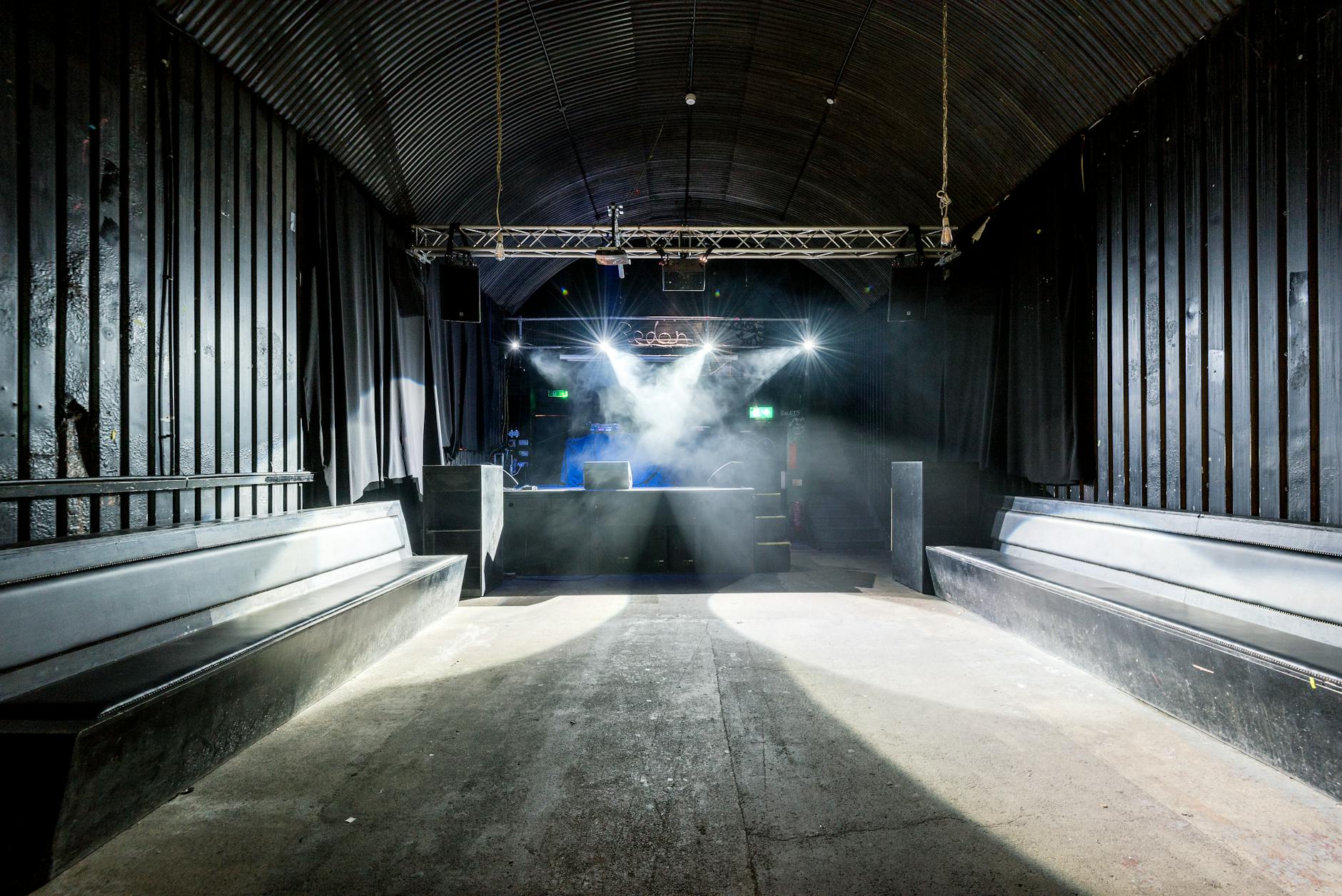
The interior design was given to Ben Kelly, who responded with the now-iconic industrial aesthetic: black-painted walls, yellow-and-black hazard stripes on the structural pillars, exposed concrete floors, and visible warehouse ductwork. The bar was minimal, the seating sparse, the dance floor cavernous. It looked like nothing else in Manchester nightlife in 1982 — a deliberately industrial space that referenced the city’s factory heritage. The build cost spiralled to somewhere between £200,000 and £350,000, an enormous figure for a small record label, and the running costs would haemorrhage money for the next five years.
The Haçienda — given the catalogue number FAC 51 — opened on 21 May 1982. The opening event was billed in a Saville-designed flyer that has become collectable in its own right. For the first half of the decade, the club struggled. The cavernous space was hard to fill mid-week, the bar takings were too low to cover overheads, and Manchester’s industrial-grey nightlife culture didn’t take immediately to a venue this conceptually ambitious. New Order’s record sales — particularly Blue Monday in 1983, which became the best-selling 12-inch single of all time — continued to subsidise the operation.

1988-89: The Second Summer of Love
Everything changed in 1987-88. Acid house — the new sub-genre coming out of Chicago and Detroit — arrived in the UK via Ibiza and then via the Haçienda’s promoters who’d heard it abroad. The club’s DJs — including Mike Pickering, Graeme Park, and Jon DaSilva — started building nights around the new sound. The combination of MDMA (newly arriving in the UK club scene), the Haçienda’s cavernous industrial architecture, the relentless 120-130 BPM rhythms, and the affordable door price produced a genuine cultural moment. By summer 1988 the Haçienda was packed every night. The walls dripped with condensation, the ceiling fans ran constantly to clear the steam, and the queue outside on Whitworth Street West stretched around the block.
The Second Summer of Love — 1988-89 — established Manchester as the European capital of dance music and made the Haçienda a globally famous venue. International DJs flew in to play; international press flew in to write about it; the city’s tourism profile transformed almost overnight. The Stone Roses’ Spike Island gig on 27 May 1990, drawing 30,000 fans, was the natural extension of the Haçienda’s cultural moment. The Madchester era — Wilson’s coined term — was effectively the live-music sibling of what the Haçienda had built on the dance floor.
1990-97: Gang Violence, Financial Collapse, and the Long Closure
Success brought problems. The Haçienda’s dance-music focus and large door takings attracted the attention of Manchester’s organised crime networks — particularly the Salford-based Quality Street Gang and several Cheetham Hill factions. By the early 1990s the club was experiencing serious incidents on a regular basis: weapons at the door, drug supply battles, occasional shootings. Door security costs spiralled. The Greater Manchester Police, the local council, and the licensing authority all began applying pressure. The club closed temporarily in 1991 (the famous “We Are Closed” press conference) and reopened with reformed security, but the underlying tensions never really resolved.
Meanwhile, the financial losses kept mounting. The Haçienda had never genuinely turned a profit — the bar takings were too low (drinkers preferred soft drinks on MDMA-heavy nights, and bottled water was the highest seller), the overheads were too high, and the venue’s reputation outpaced its accounts. Factory Records itself collapsed into administration in 1992 after a disastrous deal with London Records and the implosion of Happy Mondays’ fourth-album sessions in Barbados. The Haçienda limped on through the mid-1990s under various ownership arrangements before finally closing on 28 June 1997.
The building stood empty for five years. In 2002 it was demolished by Crosby Homes and replaced with a residential apartment block. Peter Hook (the former New Order bassist) negotiated for the new building to be named “Haçienda Apartments” — a strange kind of memorial. The blue plaque commemorating the club was mounted on the wall left of the residents’ entrance.

Visiting the Haçienda Today
The Site: 11/13 Whitworth Street West
The address is Whitworth Street West, M1 5DD — between Oxford Road and Deansgate-Castlefield, opposite the Oxford Road station’s south side. The apartment block is unremarkable; the blue plaque on the wall is small and easy to miss. Most pilgrims arrive, stand on the pavement for a few minutes, take a photo of the plaque, and leave. There is no museum, no tour of the apartments, no interpretive panel. It’s a deliberate absence — and arguably more affecting because of it.
The closest tram stop is St Peter’s Square or Deansgate-Castlefield (both 8-10 min walk). The Briton’s Protection — a perfect post-pilgrimage pub — is two minutes away on Great Bridgewater Street.
Dry Bar (FAC201) — Still Trading
If you want a working piece of Factory Records to actually have a pint in, the answer is Dry Bar at 28-30 Oldham Street in the Northern Quarter. Originally opened in 1989 as Factory Records’ own bar (catalogue number FAC 201), Dry Bar is still operating in 2026 and remains a piece of working Factory history. The interior is more contemporary than its original 1989 design but the name, the Saville-designed signage, and the cultural significance are all intact.
Hacienda Classical
The Hacienda Classical concert series — a touring show that pairs the Manchester Camerata orchestra with original Haçienda DJs Graeme Park, Mike Pickering, and others performing live orchestral reinterpretations of acid house, Madchester, and Factory Records classics — is the closest you’ll get to recreating the FAC51 experience in 2026. The show has performed annually at the AO Arena, Castlefield Bowl, and on tour internationally. Tickets typically £35-£70. Check the official Hacienda Classical schedule for 2026 dates.
Official Hacienda Merchandise
The official Haçienda store at fac51-thehacienda.com sells Saville-designed clothing, Ben Kelly hazard-stripe homeware, vinyl reissues, and limited-edition prints. Many central Manchester record shops (Piccadilly Records in particular) stock the most-popular items.
The Aviva Studios Connection
The most direct spiritual successor to the Haçienda is Aviva Studios on Water Street — Manchester’s £210m arts venue that opened on 18 October 2023 with Danny Boyle’s opening show Free Your Mind. The venue’s organisational umbrella is called Factory International, an explicit acknowledgment of the Factory Records / Haçienda lineage. The building hosts Manchester International Festival programming year-round and runs an ambitious music programme designed to give Manchester the kind of internationally significant arts venue that the Haçienda almost-but-not-quite was. If you want to experience the cultural ambition that drove Tony Wilson’s career in a 2026 setting, Aviva Studios is the answer.
The Warehouse Project
For the closest experiential match to a Haçienda night, the Warehouse Project runs annual October-January seasons at Depot Mayfield — a vast converted railway depot near Piccadilly station. A few thousand people, a single warehouse room, electronic music played loud, sweat condensing on the walls. It’s the closest thing to FAC51 that operates in Manchester today, and the cultural lineage is conscious: many of the Warehouse Project’s original promoters cite the Haçienda directly. Tickets £30-£60 for a typical season night. See our Manchester nightclubs guide.
Tony Wilson: The Man Behind Factory
Tony Wilson (Anthony Howard Wilson, 1950-2007) was a Salford-born Cambridge-educated television presenter who became one of Manchester’s most influential cultural figures of the second half of the 20th century. His Granada TV shows — including So It Goes (1976-77, the show that famously broadcast the Sex Pistols’ second TV appearance) and the long-running North West Tonight — gave Manchester music national exposure throughout the late 1970s and 1980s. He founded Factory Records in 1978, championed the Haçienda for fifteen years, coined the term “Madchester”, and laid the groundwork for what would eventually become Aviva Studios / Factory International.
Wilson died on 10 August 2007 from kidney cancer. His coffin was given the Factory catalogue number FAC 501 in a final Peter Saville design — a literal coffin-as-art-object that summed up his career-long blending of music, culture, and design. He’s buried at Southern Cemetery, Manchester — the same cemetery as artist L.S. Lowry — and the headstone reads “ANTHONY H. WILSON 1950-2007 / CULTURAL CATALYST”. The 2002 film 24 Hour Party People (Michael Winterbottom, with Steve Coogan as Wilson) remains the most-watched dramatisation of his career.
Frequently Asked Questions
Is the Hacienda still open?
No — the Haçienda closed on 28 June 1997, was demolished in 2002, and was replaced by an apartment block called Haçienda Apartments at the same address (11/13 Whitworth Street West). Only a small blue plaque on the wall marks the site.
Why did the Hacienda close?
A combination of severe financial losses (the club never genuinely turned a profit), serious gang violence and door-security incidents in the 1990s, Factory Records’ 1992 collapse, and the broader decline of the early-1990s superclub model. Final closure was 28 June 1997.
What is at the Hacienda site now?
The Haçienda Apartments — a residential building constructed in 2002 after the club’s demolition. The name was licensed from Peter Hook (former New Order bassist). A small blue commemorative plaque is mounted on the wall left of the main entrance. There is no museum, tour, or interpretive exhibit on site.
Who designed the Hacienda?
The interior was designed by Ben Kelly, who responded to the converted yacht showroom with the now-iconic industrial aesthetic — black walls, yellow-and-black hazard stripes on the pillars, exposed concrete floors, and minimal seating. The overall identity was developed alongside Peter Saville, who designed the catalogue-number system and most Factory Records visual material.
How much did the Hacienda lose?
Estimates vary, but the Haçienda is generally believed to have lost between £10 million and £20 million across its 15-year history — almost all of it underwritten by New Order’s record sales and Factory Records’ wider catalogue income.
Can you tour the Hacienda Apartments?
No — the building is a private residential apartment block. The exterior plaque can be photographed from the pavement at any time. No interior tours are offered. For the closest you can get to the Haçienda experience in 2026, attend a Hacienda Classical concert or a Warehouse Project night.
One Closing Thought
The strange thing about visiting the Haçienda site in 2026 is that there’s almost nothing to see. An apartment block. A small plaque. The rumble of Oxford Road station trains in the background. And yet the absence is the point — the way the entire Manchester music story can be triangulated from this one unremarkable pavement, the way a city can hold its musical history in negative space as much as in monuments. Pair the visit with a pint at Dry Bar, a record-shop browse at Piccadilly Records, and a Hacienda Classical ticket if you can land one, and you’ll have spent a day inside a story that genuinely reshaped global music culture — even though most of its physical evidence has been demolished, and what’s left is a quiet pilgrimage to a building that no longer exists.
For the broader Manchester music context, read our Manchester music history article, the music tours and walks guide for a guided Haçienda-inclusive route, and the Manchester music scene pillar for everything else.
Recommended Reading & Watching About the Haçienda
For visitors who want to go deeper into the Haçienda and Factory Records story before or after a Manchester visit, the canonical books and films:
- The Haçienda: How Not to Run a Club by Peter Hook (2009) — the New Order bassist’s first-hand account of the club’s finances, design, and decline.
- Substance: Inside New Order by Peter Hook (2016) — the broader New Order memoir that covers Factory Records and the Haçienda’s funding.
- 24 Hour Party People (Michael Winterbottom, 2002, with Steve Coogan as Tony Wilson) — the most-watched cinematic dramatisation of the Factory Records story.
- Control (Anton Corbijn, 2007) — the Joy Division biopic centred on Ian Curtis, with significant Manchester music scene context.
- The Stone Roses: Made of Stone (Shane Meadows, 2013) — the Madchester-adjacent documentary covering the band’s 2012 reunion.
- New Order: Decades (Mike Christie, 2018) — feature documentary on New Order’s career and Manchester roots.
- Tony Wilson Said (various podcast episodes) — multiple Manchester music podcasts collect Wilson’s interviews and Granada TV appearances.
- Use Hearing Protection: The First Four Years of Factory Records by Simon Spence — definitive account of the label’s early period.
Most of these are available at central Manchester bookshops including Waterstones Deansgate and Blackwell’s University Bookshop on Oxford Road.