This article contains advertising. Our booking links are routed through a partner that adds commission tracking automatically, so if you book through one we earn a commission from the provider, at no extra cost to you. It never affects what we recommend. Affiliate disclosure
Manchester didn’t host the Industrial Revolution so much as invent it. The first commercial steam-powered cotton mill, the first true canal, the first inter-city passenger railway, the first municipal park, the first free public library, the first analytical chemist, the first computer — all happened here, in a small, smoky, briefly extraordinary northern city that the Victorian writer Benjamin Disraeli called “the most wonderful city of modern times”. For roughly seventy years from the 1780s through the 1850s, Manchester was the city the entire world watched, because what was happening here was about to happen everywhere.
The phrase the Victorians gave it was Cottonopolis. A whole city built around one fibre — raw cotton arriving by canal and rail from Liverpool docks, spun and woven in the world’s first purpose-built factories, traded on the floor of the Royal Exchange, and exported back out to every continent. By 1853 there were 108 cotton mills inside Manchester’s boundary and another 1,800 across Lancashire. The city’s population multiplied tenfold in eighty years. It was rich beyond anything Britain had seen, and it was also, by any honest accounting, brutal — child apprentices working fourteen-hour shifts, air thick enough to be sliced, life expectancy in the back-to-back terraces of Ancoats so low that Friedrich Engels could walk through it and decide capitalism would have to be replaced.
This guide is for visitors who want to understand and actually see that history rather than just read about it. The good news is that more of industrial Manchester survives than people assume — the world’s first inter-city railway terminus is now a free museum, the first canal still runs through the city centre, an actual working cotton mill operates twenty minutes from Piccadilly, and the world’s first industrial suburb (Ancoats) has just become one of the trendiest neighbourhoods in northern Europe. You can walk all of it in an afternoon. Here’s how.
Why Manchester Is Called the World’s First Industrial City
The claim sounds like marketing puffery until you check it against the timeline. Other cities had factories before Manchester — Derby’s silk mill of 1721 is usually cited as the first true factory anywhere. But Manchester is where the cluster effects happened. Where the canal, the steam engine, the cotton mill, the warehouse district, the trading exchange, the railway and the working-class districts all came together in one place, at one moment, and started reproducing each other.
The triggering invention was Richard Arkwright’s water frame in 1769, followed by Samuel Crompton’s spinning mule in 1779. These machines made it possible to spin cotton thread at industrial speeds. Within a decade Manchester had three steam-powered mills — the first being on Miller Street in the Shudehill area in 1781. Within two decades there were dozens. Within three, the city was unrecognisable.
The reason Manchester rather than Liverpool or Leeds was the cotton capital is partly geography (soft water from the Pennines, ideal for textile processing), partly geology (coal underfoot), and partly historical accident (Lancashire weavers had been producing fustian cloth for two centuries, so the skills were here). But the deciding factor was the Bridgewater Canal of 1761, which connected the Duke of Bridgewater’s coalmines at Worsley to the centre of Manchester and halved the price of fuel almost overnight. From that moment, the city had the cheapest energy in Britain. The mills followed.
For a wider sense of the city’s whole story, our Manchester history and heritage guide covers the full arc from Roman fort to modern renaissance.

The Rise of Cottonopolis: A Quick Timeline (1761–1914)
1761: Bridgewater Canal opens between Worsley and Castlefield. Manchester coal price falls by half within a year.
1769: Richard Arkwright patents the water frame in Cromford, Derbyshire.
1781: Arkwright opens Manchester’s first steam-powered cotton mill at Shudehill.
1784: Quarry Bank Mill founded by Samuel Greg at Styal, twelve miles south of Manchester. Still operating today as a museum.
1798: Murray’s Mills opens in Ancoats — the world’s largest cotton-spinning complex on a single site, and the first to be powered entirely by steam.
1804: Rochdale Canal opens, completing the first cross-Pennine canal route. Castlefield basin becomes the world’s first inland port.
1819: Peterloo Massacre at St Peter’s Field. 18 killed, 700 injured. The roots of modern democratic politics.
1830: Liverpool & Manchester Railway opens — the world’s first inter-city passenger railway. Liverpool Road Station, the Manchester terminus, is now the oldest surviving railway station in the world and the heart of the Science and Industry Museum.
1842: Friedrich Engels arrives to work at his father’s Ermen & Engels mill in Salford. Spends the next two years walking the city’s worst districts.
1845: Engels publishes The Condition of the Working Class in England. Manchester becomes the negative template for industrial capitalism.
1853: Peak of Cottonopolis. 108 cotton mills inside Manchester, 1,800 across Lancashire. Manchester spinning roughly a third of the world’s cotton.
1861–65: Lancashire Cotton Famine. The American Civil War cuts off Confederate cotton imports. Hundreds of Manchester mills close. Tens of thousands of workers face starvation. Despite the hardship, a mass meeting at the Free Trade Hall in December 1862 votes to support Lincoln and the Union.
1894: Manchester Ship Canal opens. Ocean-going ships now reach the city directly. Salford Docks becomes Britain’s third-busiest port.
1914: Outbreak of World War One. The cotton trade never fully recovers.
Science and Industry Museum: Where the Story Lives
If you do one thing in industrial Manchester, do this. The Science and Industry Museum on Liverpool Road occupies the world’s oldest surviving railway station — the 1830 terminus of the Liverpool & Manchester Railway. The site itself is a UNESCO World Heritage-class location. The museum is free.
The headline space is the Power Hall, which reopened in October 2025 after six years of restoration. It houses one of the world’s great collections of working stationary steam engines — and they actually work. At scheduled times throughout the day, the engineers fire them up. Watching a Victorian mill engine come to life, hissing and breathing, with all its brass and cast iron in motion, is one of the great Manchester experiences. Bring a child if you have one; they will not forget it.
Other highlights: the 1830 Warehouse with its original cotton bales and trading desks; the Experiment! gallery for hands-on physics; the textile gallery with working spinning mules and looms; and the railway exhibition in the original 1830 Station. There’s also the new Special Exhibitions Gallery, currently hosting “Horrible Science: Cosmic Chaos” through to early 2027.
Allow at minimum three hours. Realistically half a day. Our complete Science and Industry Museum guide has the proper detail. It’s free. Pre-book a free admission ticket online and you skip the entrance queue.

Castlefield and the Bridgewater Canal: Where It All Began
Castlefield is the oldest part of central Manchester — the site of the Roman fort of Mamucium, the terminus of the Bridgewater Canal, and Britain’s first Urban Heritage Park (designated 1982). It is also the most photogenic part of the city. Victorian railway viaducts on three levels, Georgian canal basins, and the recently opened National Trust sky garden on Castlefield Viaduct combine to make this the place visitors photograph the most after the Northern Quarter.
To understand the Industrial Revolution properly, walk this loop. Start at Deansgate-Castlefield Metrolink. Drop down to the canal basin. Walk past the Merchants’ Warehouse (1825, the oldest surviving warehouse in Manchester). Cross Lock 92 where the Bridgewater Canal meets the Rochdale Canal. Pass Dukes 92 (the city’s classic canalside pub, in the old stable block of the canal company). Walk under the Castlefield Viaduct (the railway bridge now turned sky garden — book a free timed slot online). Continue to Liverpool Road and the Science and Industry Museum. The whole loop is under 2 kilometres and takes 30-45 minutes without stopping, or three hours with the museum visit folded in.
For a wider Castlefield exploration, our Deansgate and Castlefield guide covers the whole quarter. And for canal-focused walks specifically, our Manchester canals guide goes into the full network.
Ancoats: Walking the World’s First Industrial Suburb
If Castlefield is where the canals built the city, Ancoats is where the factories did. The neighbourhood — fifteen minutes’ walk north-east of Piccadilly Station — has been called “the world’s first industrial suburb”. It was here, between 1798 and 1840, that the largest cluster of steam-powered cotton mills on the planet rose along the Rochdale Canal.
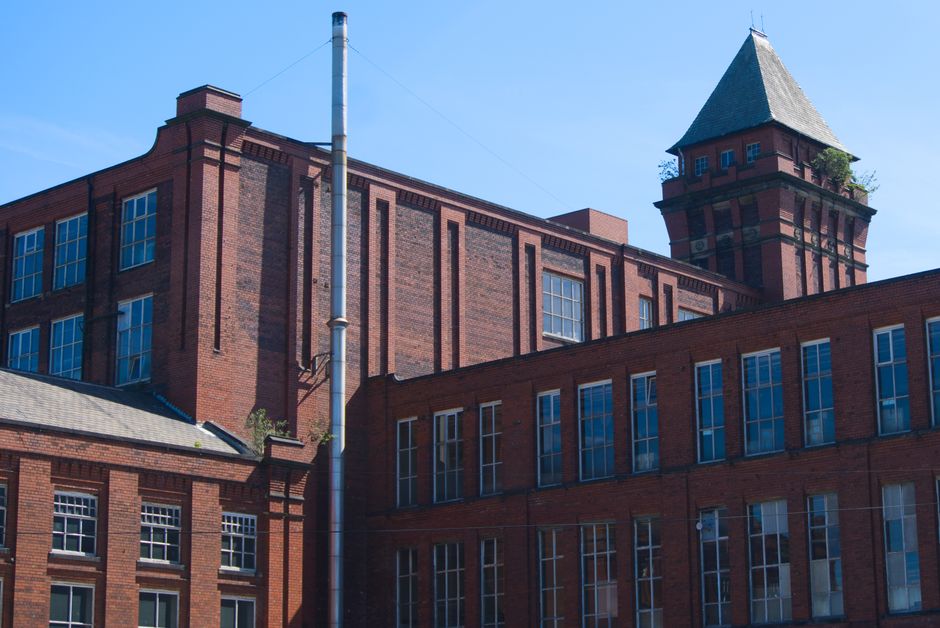
The mills are still there. Murray’s Mills (1798), now Grade II*-listed, was once the world’s largest cotton-spinning complex; Royal Mills was the showpiece of the Murrays’ empire. Beehive Mill (1824) is now a creative arts and music venue. The whole area has, in the last fifteen years, been transformed from a derelict warren of warehouses into one of the most desirable neighbourhoods in northern Europe — converted mill apartments, a Michelin-starred restaurant scene, and Cutting Room Square as its open-air heart.
Walking it is the trick. Start at Mackie Mayor (food hall — see our family restaurants guide). Walk through Stevenson Square. Cross into Cutting Room Square. Find the four “Ancoats Peeps” — brass portholes set into the cobbles, each looking through to a hidden industrial scene. Walk up Bengal Street past Royal Mills and turn onto Murray Street. Look up at Murray’s Mills — this is the literal mother factory of the modern world.
For Ancoats as a present-day neighbourhood, our Ancoats Manchester guide covers it in full.

Quarry Bank Mill: A Working Cotton Mill You Can Still Visit
You can read all the history you like and still not understand what an early industrial mill was actually like inside. The only way to feel it is to visit Quarry Bank Mill at Styal, twenty minutes south of Manchester on the train.
Founded in 1784 by Samuel Greg, Quarry Bank is the most complete surviving early-Industrial cotton mill in the world. The National Trust runs it. The mill still has its 1838 iron water wheel — the largest still operating in Europe — and the mule spinning room still operates demonstration machines. You can stand on the worker’s side of the spinning frame and feel the noise, the heat, the cotton dust still on the floorboards. It is unforgettable.
But the harder visit is the Apprentice House, a few minutes’ walk from the mill in the wooded valley. This is where the pauper children — apprentices brought from the parish workhouses of London, Liverpool and Manchester — lived. Aged five to fourteen. They worked twelve-hour shifts in the mill and slept four to a bed in the apprentice dormitory. The Trust’s interpreters, properly trained, walk you through their day. It’s confronting. It is also one of the most honest pieces of museum work in Britain.
Visiting in 2026: Grounds open 8am-6pm. Mill and Apprentice House open 10am-5pm. Adult £12, child £6. National Trust members free. Take the train to Styal station (about 20 minutes from Manchester Piccadilly) — Quarry Bank is a five-minute walk from the station. Or drive (free parking).
The Mills, Warehouses and Exchange of Cottonopolis
Cotton needed three things to become a global industry: somewhere to spin it, somewhere to store the raw and finished material, and somewhere to trade it. Manchester built all three at industrial scale.
The spinning happened in the mills — those in Ancoats and Salford, plus dozens of others scattered across the inner suburbs. By 1853 the city had 108 of them, mostly five to seven storeys high, all powered by steam.
The storage happened in the warehouses. The Portland Street and Whitworth Street districts (the area now bounded roughly by Oxford Road, Piccadilly, and the canal) became the warehouse capital of the world. These weren’t simple sheds — they were ornate Victorian palaces of trade. Some are still there. The Britannia Hotel on Portland Street was originally a textile warehouse. So was Velvet Hotel. So was much of the Princess Street and Whitworth Street corridor.
The trading happened at the Royal Exchange on St Ann’s Square. Built in 1874 (rebuilt 1921 after war damage), the Royal Exchange floor was the largest trading floor in Britain. At its peak, 11,000 cotton merchants would gather here on a Tuesday afternoon to trade. The floor closed in 1968 with the collapse of the cotton trade; the building reopened in 1976 as the Royal Exchange Theatre, with a futuristic seven-sided steel-and-glass theatre pod suspended inside the Victorian hall. You can walk in for free during opening hours. It’s astonishing — go and see.
For more on the city’s architectural heritage, our historic buildings and architecture guide covers the lot.
The Human Cost: Workers, Children and the Cotton Famine
You can’t tell the story of Cottonopolis honestly without telling the cost. The mills made enormous fortunes for a small number of owners. They made starvation wages for tens of thousands of workers. They made child labour into a system.
The Apprentice House at Quarry Bank shows you what apprenticeship looked like. The streets of Ancoats and Hulme — both extensively documented by Engels in 1844 — show you what worker housing looked like. Cellar dwellings (literal underground rooms housing whole families), back-to-back terraces with one outdoor privy per twenty houses, and life expectancy in the worst districts of about seventeen years.
The Lancashire Cotton Famine of 1861-65 is where the moral arc of the story turns. The American Civil War cut off the supply of Confederate cotton. Manchester mills closed. Hundreds of thousands of workers were thrown out of work. They faced actual starvation. And yet — at a mass meeting at the Free Trade Hall on 31 December 1862 — Manchester’s cotton workers voted to support President Lincoln and the Union, even though doing so meant prolonging their own poverty. Lincoln replied with a letter of thanks describing their stance as “sublime Christian heroism”. A statue of Lincoln, inscribed with that letter, stands in Lincoln Square in Manchester to this day. It is one of the most moving pieces of public history in Britain. You can read more about Manchester’s radical political tradition in our Manchester political history guide.
Marx, Engels and the Politics Born in Manchester’s Reading Rooms
Friedrich Engels moved to Manchester in 1842 to work at his father’s cotton mill in Salford. He stayed off and on for thirty years. In that time he wrote The Condition of the Working Class in England (1845), which described in forensic detail what industrial Manchester actually looked and smelt and felt like, and met Karl Marx, who came to visit him repeatedly. The two of them met regularly at Chetham’s Library — Manchester’s oldest free public library, founded in 1421 — to read and write. The desk at which they sat together, in the bay window overlooking the cloister, is still there. The library is free to visit Monday-Friday. You can sit at that desk. It is one of the strangest, most consequential pieces of furniture in modern history.
For more on the wider radical-thinker network, the Working Class Movement Library in Salford holds the country’s largest collection of working-class political pamphlets, banners and books. The People’s History Museum on the Left Bank covers the same ground for visitors. Both are free.
And Chetham’s itself is unmissable. The library room is medieval, oak-panelled, smells of old books, and is one of the most atmospheric spaces in the city. Our Chetham’s Library guide covers the visit in detail. Free, weekdays only, booking recommended.
A Self-Guided Industrial Heritage Walking Route
The most efficient half-day walk if you want to see the heart of Cottonopolis:
Start at Manchester Cathedral (free; medieval origins, sits on the oldest civic site). Walk five minutes to Chetham’s Library (free, weekdays; the Marx and Engels desk). Across the river, glance at Manchester Victoria Station (1844, partly preserved). Walk through Cathedral Gardens — past the new Glade of Light memorial — into the National Football Museum building (free entry to the building lobby; ticketed for the museum proper). Cross Corporation Street to The Triangle (formerly Corn Exchange). Walk to St Ann’s Square and the Royal Exchange Theatre (free entry to the theatre hall). Cross to Albert Square for the Town Hall (currently in final-stage restoration; check 2026 reopening status). Continue to Lincoln Square for the Lincoln statue. Walk down John Dalton Street to Spinningfields. Take Quay Street west and you arrive at Castlefield basin for the canal, the Roman fort remains, Castlefield Viaduct (book in advance), and the Science and Industry Museum.
If you have a second day, take the train to Styal for Quarry Bank Mill, or walk out from Piccadilly to Ancoats for the mills and the food halls.
This is one of the best free history walks in any European city. Our walking tours guide has it laid out in more detail.
Practical Visitor Tips for 2026
Most of the industrial heritage sites in Manchester are free. The Science and Industry Museum, the People’s History Museum, Manchester Museum, Chetham’s Library, John Rylands Library, the Working Class Movement Library, the Royal Exchange foyer, the Castlefield basin, the Ancoats Conservation Area, the Lincoln statue — all free. The two main exceptions are Quarry Bank Mill (paid, NT members free) and the Castlefield Viaduct sky garden (free but timed booking).
Public transport: the Metrolink covers most of the central sites, and the Science and Industry Museum is two minutes’ walk from Deansgate-Castlefield tram stop. Quarry Bank is a 20-minute train from Manchester Piccadilly to Styal. The Bee Network buses cover everywhere else cheaply. Our getting around Manchester guide has the transport details.
Best time to visit: anytime, honestly — most of the museums are indoor and weather-resistant. The canal walks and Castlefield are obviously better when it’s dry, but Manchester being Manchester, accept that rain is part of the experience. Bring a coat.
One last suggestion. After you’ve done the museums, find a canalside pub for a pint. Dukes 92, the Knott Bar, the Wharf — all overlook the basin where the Bridgewater Canal terminates. Sit for an hour with a beer and look at the warehouses, the lock, the viaducts, the water. This is where the modern world started. It’s a strange thing to drink a pint over, and that’s exactly the point.
The surviving Victorian brick is exactly why film crews come here. Our Peaky Blinders filming locations guide follows the streets and canals that stood in for a Birmingham that no longer exists.