This article contains advertising. Our booking links are routed through a partner that adds commission tracking automatically, so if you book through one we earn a commission from the provider, at no extra cost to you. It never affects what we recommend. Affiliate disclosure
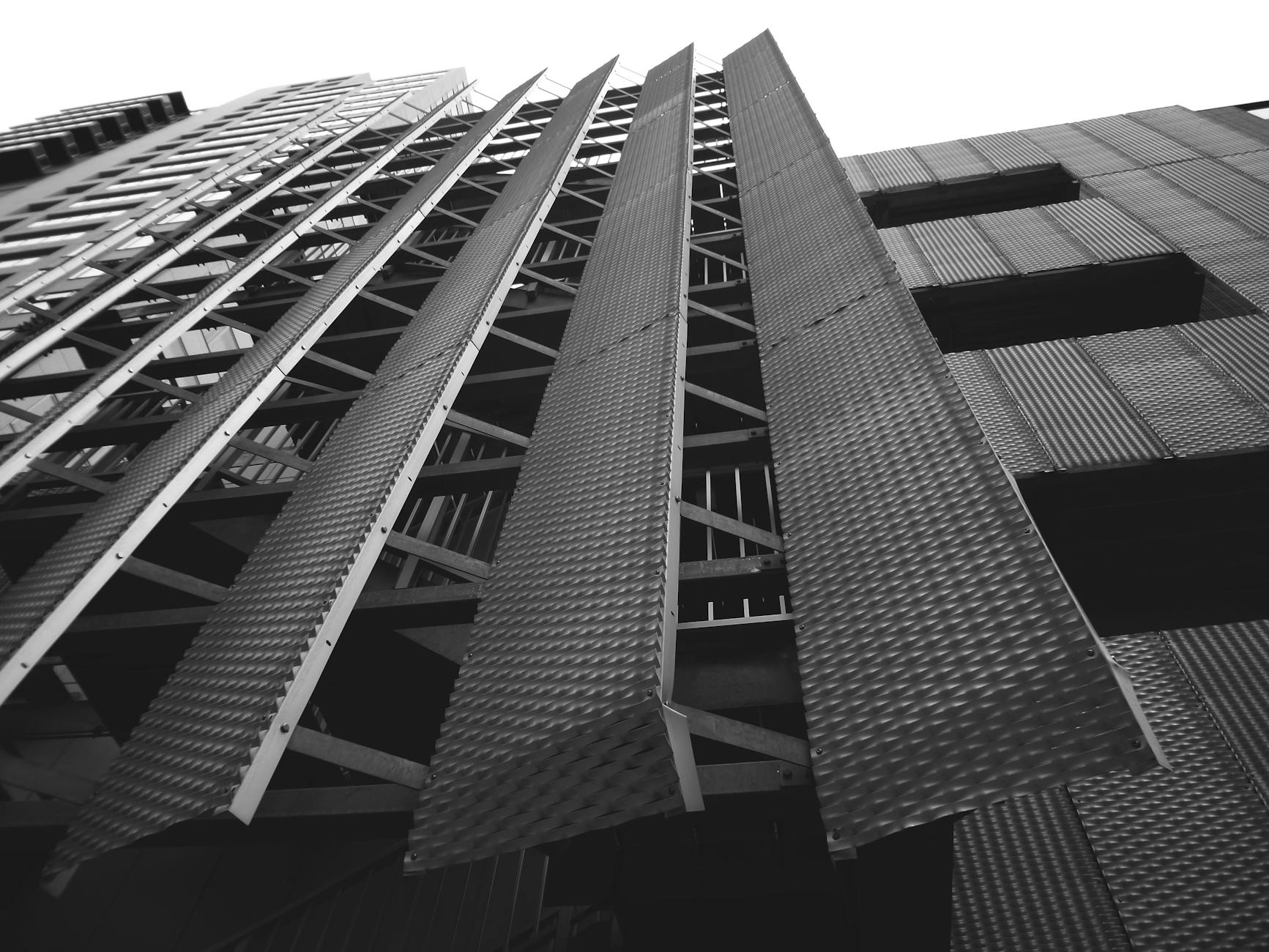
Daniel Libeskind described his concept for the Imperial War Museum North as “a globe shattered by conflict and reassembled into three shards — earth, air and water.” He meant it. The building you see on the Salford waterfront, opposite The Lowry across the Manchester Ship Canal, is three interlocking jagged forms in zinc, aluminium and concrete, designed to evoke the disorientation and fracture of modern war. It was his first UK commission. It opened in 2002. It is free to walk in. And inside there is a 360-degree projection show on 18-metre walls that runs every hour, on the hour, and reduces grown adults to tears in eight and a half minutes.
This is the 2026 visitor guide to Imperial War Museum North — the building, the Big Picture Show, the collection (Harrier jump jet, Russian T-34 tank, World Trade Center steel, the WE 177 nuclear bomb, L.S. Lowry’s Going to Work), how to visit, and how to combine it with a Salford Quays day. For the wider Quays context see our Salford Quays and MediaCityUK guide.
Imperial War Museum North at a glance
- Address: The Quays, Trafford Wharf Road, Trafford Park, Manchester M17 1TZ
- Hours: Daily 10am–5pm (last admission 4.30pm). Closed 24–26 December.
- Admission: Free, no booking required. Some temporary exhibitions paid.
- How long: 90 minutes minimum, 2–3 hours typical, half a day if you watch multiple Big Picture Shows and a special exhibition.
- Nearest tram: MediaCityUK, Wharfside, or Harbour City on the Trafford Park Metrolink line.
- Parking: Secure car park on site, 160 spaces, £5/4hr, £7/6hr, £15/24hr.
- Suitable for: Ages 7+ for self-guided visits; free family missions for ages 5+ at weekends and school holidays.
Why visit IWM North?
Three good reasons:
First, the building. Daniel Libeskind designed the Berlin Jewish Museum and the Dresden Military History Museum; the Imperial War Museum North was his first UK work and remains one of the most striking examples of deconstructivist architecture in Britain. The “shattered globe” concept is not a metaphor you have to be told about — you feel it the moment you walk in. The Earth Shard’s main exhibition floor is curved, dropping away from the “North Pole” entrance by about 8 feet, deliberately disorientating.
Second, the Big Picture Show. Every hour, the lights in the Main Exhibition Space dim, the entire museum goes quiet, and a multi-screen 360-degree projection runs across 18-metre walls — photographs, archive film, oral-history audio, music. Under 10 minutes. The current 2026 rotation includes pieces on wartime animal heroes, the 1945 Fifth Pan-African Congress that took place in Manchester, and Tony Walsh’s poem Mightier Than War. It is one of the most affecting museum experiences in the UK.
Third, the collection approach. IWM North does not arrange weapons-by-era like a traditional military museum. The main exhibition runs chronologically but is overlaid with six thematic “silos” (Women and War, Experience of War, Empire and War, etc.) that surface the human stories rather than the hardware. Free entry to all of it.
The building: Daniel Libeskind’s first UK work
The architect
Daniel Libeskind is the Polish-American architect who designed the Berlin Jewish Museum (his breakthrough project), the master plan for the Ground Zero / World Trade Center site after 9/11, the Dresden Military History Museum extension, and the Royal Ontario Museum extension. His family suffered in the Holocaust — both his parents were survivors — and his work returns repeatedly to themes of memory, loss, and rupture. He won the IWM North commission in 1997, with the museum opening on 5 July 2002, just before Manchester’s Commonwealth Games.
The three shards
Libeskind’s concept: a globe shattered by conflict, the pieces reassembled to symbolise the war that fragments the world. The building has three interlocking shards:
- Earth Shard — the main 3,500-square-metre exhibition hall. Curved floor; the “North Pole” entrance is the highest point and the floor drops away around you, recreating the curvature of the globe (and the disorientation of arrival in a war zone).
- Air Shard — a 55-metre tower; the entrance for visitors. Originally with a viewing platform at the top (currently access varies — check the official site before relying on it).
- Water Shard — a low building over the Manchester Ship Canal containing the WaterShard Café and Kitchen, with terrace views over the water to The Lowry and Old Trafford.
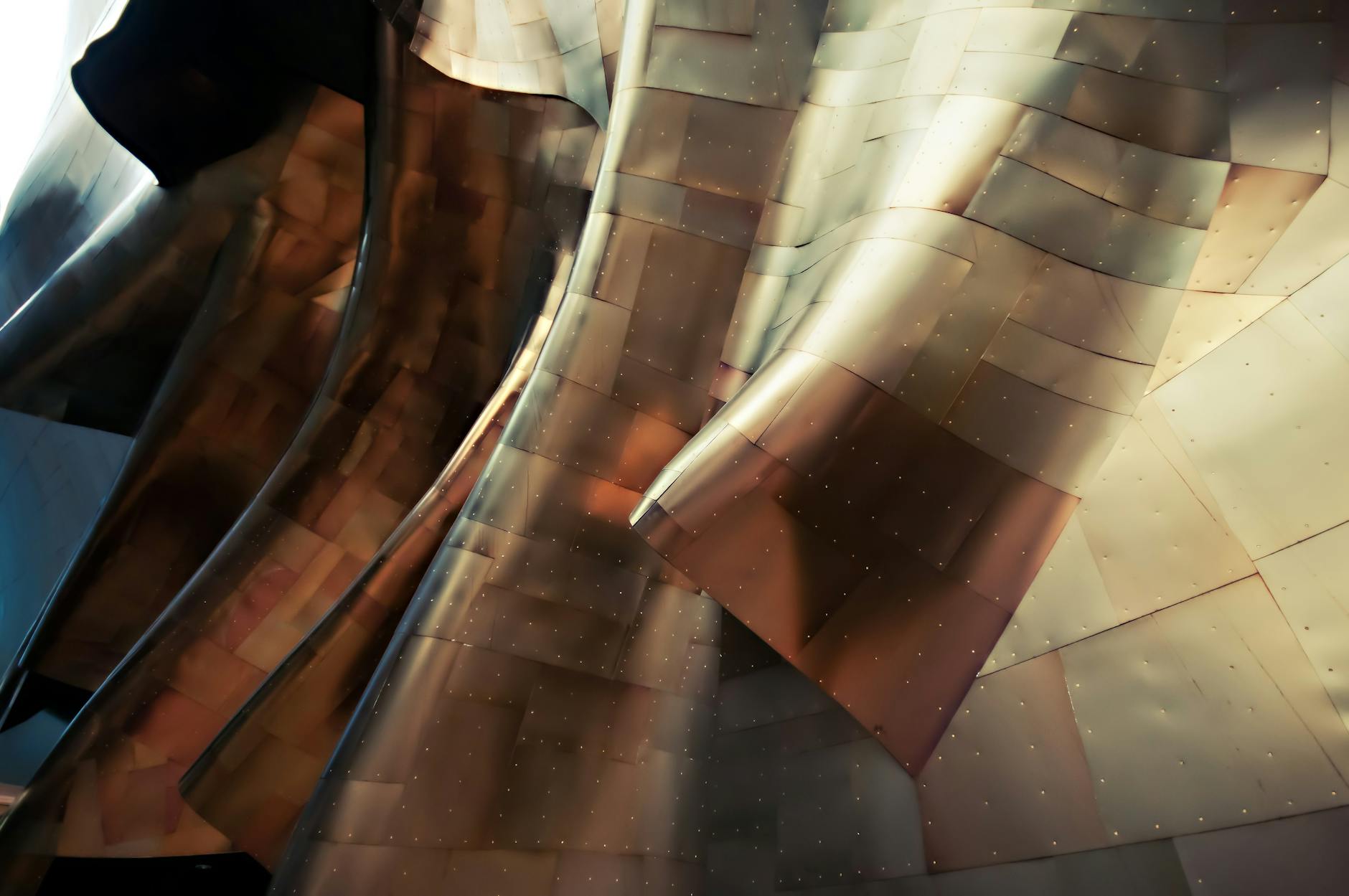
The exterior is clad in zinc, aluminium and concrete — neutral tones that change colour with weather and light. Awards: 2003 British Construction Industry Building of the Year; shortlisted for the 2004 Stirling Prize; named one of the Top 10 English buildings of the last century by Rough Guide (2008).
The Main Exhibition
The chronological main exhibition runs from WWI to the present, with the six thematic silos cutting across the timeline. Headline objects to seek out:
- USMC AV-8A Harrier jump jet suspended from the ceiling at the entrance — the museum’s signature object.
- Russian T-34 tank — the largest object on display, the most-produced tank of WWII.
- QF 13-pounder field gun — fired the British Army’s first shot of the First World War, on 22 August 1914 in Belgium.
- World Trade Center steel — a 7-metre mangled steel column from the South Tower, gifted in 2010. Particularly poignant given Libeskind’s parallel work on the Ground Zero master plan.
- Berlin Wall fragment + an East German Trabant car.
- WE 177 — a British thermonuclear bomb (deactivated; the casing). Astonishingly small for what it is.
- Rolls-Royce Olympus 101 jet engine, Mk XVII contact sea mine.
- Rudolf Hess plane wreckage — pieces of the Messerschmitt Bf 110 that the Deputy Führer crashed in Scotland in May 1941 on his bizarre solo “peace mission”.
- Holocaust artefacts — yellow stars from Nazi-occupied Europe, Majdanek concentration-camp prisoner uniforms, a doll made by a prisoner from concentration-camp cloth. Treated with proper care; not the dominant note, but unforgettable.
- Scorched tiles from Hiroshima.
- Oscar statuette for The True Glory (1945 Best Documentary).
- War art — including L.S. Lowry’s Going to Work (1943, a commission about workers at Manchester’s wartime factories), Anna Airy’s The ‘L’ Press’ and Flora Lion’s Building Flying-Boats.
- Trench Stenches — an interactive lift-the-lid smell quiz on what the WWI trenches actually smelled like (vomit, latrines, gunpowder, mud). Kids love it; adults make a face and move on.
The Big Picture Show
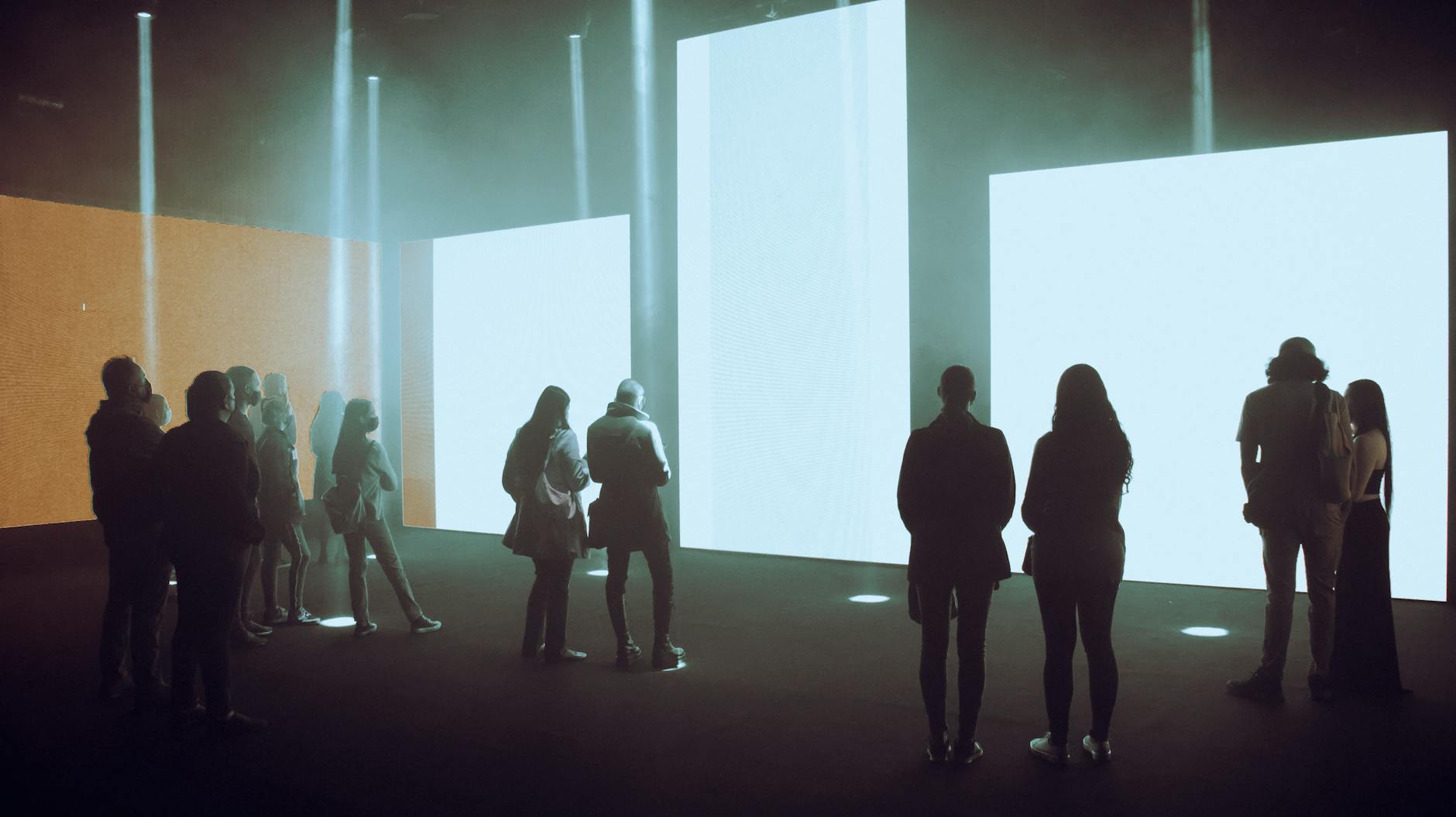
The Big Picture Show is the heart of the visit. Originally created with 60 synchronised slide projectors in 2002, upgraded to digital projection in 2011, it runs every hour on the hour and lasts under 10 minutes. The Main Exhibition lighting dims to near-black; the entire museum stops what it is doing; and the photographs and films run on the surrounding walls with surround sound.
Each show is themed and the rotation changes periodically. The current 2026 cycle includes:
- Wartime animal heroes — Duffy the donkey, Rip the dog, K-Dog the dolphin, the carrier pigeons of WWI and WWII.
- The Roads We Walked: The Fifth Pan-African Congress — the 1945 Manchester congress that brought together Kwame Nkrumah, Jomo Kenyatta and other future independence leaders, marking its 80th anniversary in 2025.
- Mightier Than War — a commissioned poem by Manchester poet Tony Walsh (best known for the post-Arena-bombing This Is The Place).
The show timings are listed at the welcome desk on arrival. Plan to be in the Main Exhibition Space when it starts.
The Air Shard viewing area and views
The 55-metre Air Shard tower offers panoramic views over the Manchester Ship Canal, MediaCityUK, The Lowry, Old Trafford, and the wider Salford Quays. Access depends on staffing and weather; check with the welcome desk on arrival. When open, lift access takes you up; the viewing area is open to the elements on the upper levels.
Special exhibitions and Poppies installation
The museum runs a programme of temporary exhibitions in its dedicated Special Exhibitions Gallery (sometimes paid, sometimes free). Recent shows have covered the Falklands War, the Holocaust, and the history of war photography. The Poppies: Wave installation — part of the iconic Tower of London commemoration of WWI’s centenary — has been displayed at IWM North in the Air Shard south side; check current display status on iwm.org.uk before visiting.
Visiting with kids
IWM North is suitable for ages 7+ for self-guided visits — younger children can find some content distressing (Holocaust artefacts, modern war photography). For families with younger children, the museum runs free family missions and adventure trails at weekends and school holidays for ages 5+, including:
- Interactive Trench experience.
- Camouflage and code-breaking activities.
- Learning Studio craft activities.
- Trench Stenches smell quiz (always available).
The Big Picture Show is suitable for older children but can be intense — judge by your child. Baby-changing and accessible facilities throughout.
WaterShard Café and the shop
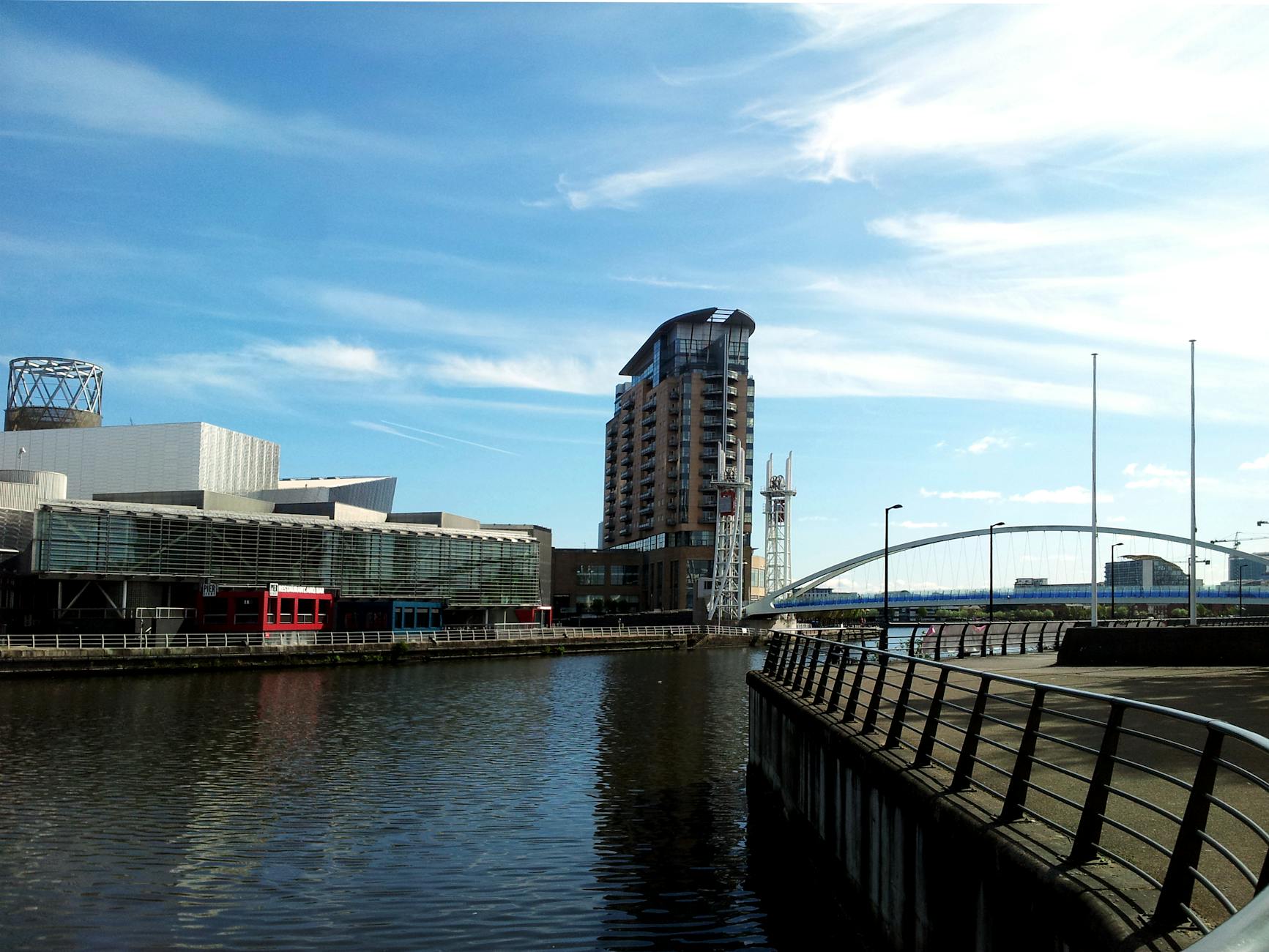
The WaterShard Café and Kitchen in the Water Shard has glass walls overlooking the Ship Canal towards The Lowry. Lunch menus, hot drinks, cakes. Allow time for a coffee with the view — particularly on a clear day, you can see Old Trafford from the terrace.
The ground-floor museum shop stocks books on war history, model kits, kids’ games, and Manchester / IWM-themed gifts.
How to get there
By tram (best option)
The Trafford Park Metrolink line runs from Manchester city centre (St Peter’s Square or Deansgate–Castlefield) to Wharfside, MediaCityUK, or Imperial War Museum (the dedicated stop just outside the museum). About 15–20 minutes from Piccadilly; trams every 12 minutes weekdays. Single fare £3.10 adult.
By foot from The Lowry / MediaCityUK
If you’re combining with a Salford Quays day, cross the silver Lowry Footbridge (Lowry / Detroit footbridge) over the Manchester Ship Canal. Three minutes’ walk; the museum is directly on the other side.
By car
M60 → M602 toward Manchester city centre → junction 3 roundabout, third exit onto Trafford Road → A5081 to Trafford Park (signposted). On-site secure car park: 160 spaces, £5 for 4 hours, £7 for 6 hours, £15 for 24 hours. Blue Badge parking available.
By bus
Multiple bus routes (including the Stagecoach 250) stop on Trafford Wharf Road near the museum.
Pair with a Salford Quays day trip
IWM North works brilliantly as part of a Salford Quays day. Suggested itinerary:
- 10am — Tram to MediaCityUK. Coffee on the piazza, walk past the Blue Peter Garden.
- 11am — Lowry Footbridge over the canal to IWM North. 2 hours including the 12pm Big Picture Show.
- 1pm — Lunch at WaterShard Café or back across the bridge to Kargo MKT food hall at MediaCityUK.
- 2pm — The Lowry (galleries free, 90 minutes for the LS Lowry collection).
- 3.30pm — Optional: BBC Studio Tour (book ahead) or Coronation Street Experience (Trafford Wharf Road).
- 6pm — Pre-theatre dinner at Pier Eight, then a Lowry Theatre show, or tram back to town.
See our Salford Quays guide for the wider picture and our Lowry guide for the cultural anchor.
Accessibility
The museum is fully step-free with lifts to all floors. Accessible toilets, hearing loops, large-print guides. A Changing Places toilet is on site. The Big Picture Show area has BSL videos available. Sensory backpacks for autism-friendly visits are available from the welcome desk. The museum runs periodic relaxed openings for autism-friendly mornings — check the IWM events page.
FAQ — Imperial War Museum North
Is Imperial War Museum North free?
Yes — admission is free, no booking required. Some temporary exhibitions are sometimes paid.
How long does it take to visit IWM North?
90 minutes minimum, 2–3 hours typical, half a day if you include multiple Big Picture Shows and a special exhibition.
What are the opening times?
Daily 10am–5pm, last admission 4.30pm. Closed 24–26 December.
What is there to see at IWM North?
2,000+ objects from WWI to the present: USMC Harrier jump jet, Russian T-34 tank, 9/11 World Trade Center steel, QF 13-pounder gun (first British shot of WWI), WE 177 nuclear bomb, Berlin Wall, Rudolf Hess plane wreckage, Holocaust artefacts, L.S. Lowry’s Going to Work, the hourly Big Picture Show.
Who designed the IWM North building?
Daniel Libeskind — his first UK building. He also designed the Berlin Jewish Museum and the master plan for the World Trade Center site after 9/11.
What is the Big Picture Show?
An hourly 360-degree projection on 18-metre walls — surround sound, archival photographs and film, music. Under 10 minutes. Current 2026 themes include wartime animal heroes, the Fifth Pan-African Congress, and Tony Walsh’s poem Mightier Than War.
Is IWM North good for kids?
Suitable for ages 7+ for self-guided visits; free family missions and adventure trails for ages 5+ at weekends and school holidays. Some content (Holocaust artefacts, modern war photography) may be intense for younger children.
Is IWM North worth visiting?
Yes — consistently rated among Manchester’s best free attractions. The combination of Libeskind’s building, the Big Picture Show, and the human-focused collection makes it stand out from traditional military museums.
How do I get to IWM North from Manchester city centre?
Metrolink Trafford Park line from St Peter’s Square or Deansgate–Castlefield to Wharfside, MediaCityUK, or Imperial War Museum stop. 15–20 minutes.
Where do I park at IWM North?
On-site secure car park, 160 spaces, £5/4hr, £7/6hr, £15/24hr. Blue Badge parking available.
Is the Air Shard viewing area open?
Access varies by staffing and weather — check at the welcome desk on arrival.
Plan more of your Manchester visit
IWM North pairs naturally with the rest of Salford Quays. Our Salford Quays and MediaCityUK guide covers the wider area; our Lowry guide covers the cultural anchor across the footbridge; our free museums in Manchester guide has the citywide list. For everything, see our Manchester museums and culture pillar.