
This article contains advertising. Our booking links are routed through a partner that adds commission tracking automatically, so if you book through one we earn a commission from the provider, at no extra cost to you. It never affects what we recommend. Affiliate disclosure
The Reading Room at Chetham’s Library is a small, low-ceilinged 15th-century chamber off a cobbled cloister, lined with chained books and dominated by a wood-panelled four-sided desk under a window. The desk has been there since the 17th century. In the summer of 1845, two young men sat at it together to read up on political economy: Friedrich Engels, then a 24-year-old commercial agent at his father’s Manchester cotton firm, and his London visitor Karl Marx. The reading they did at that desk fed directly into The Communist Manifesto, published three years later. The desk is still there. The alcove is still there. The library is still operating exactly as it has for 372 years — Britain’s oldest free public reference library, founded by an extraordinary 1653 act of philanthropy by the Manchester cotton merchant Humphrey Chetham, and continuously open to anyone who wants to come and read.
This is the 2026 visitor guide to Chetham’s Library — the medieval buildings, the collections, the Marx and Engels story, the guided-tour booking process (essential — you cannot just walk in), and a wider look at Manchester’s other historic libraries (the Portico, Manchester Central Library). For wider cultural context see our museums and culture pillar and our John Rylands Library guide for the sister Victorian Gothic library.
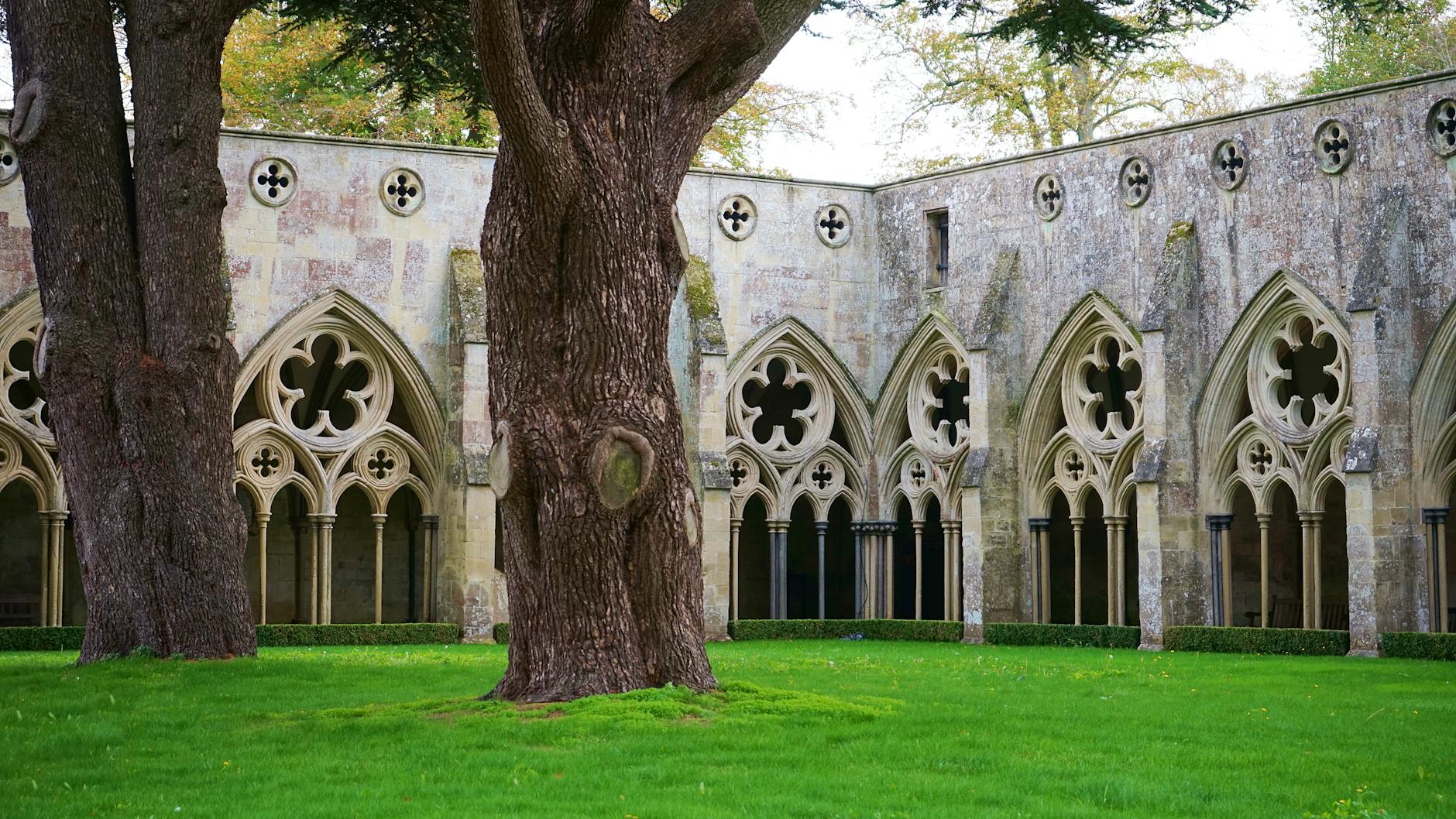
Chetham’s Library at a glance
- Address: Chetham’s Library, Long Millgate, Manchester M3 1SB (next to Manchester Cathedral and Manchester Arena)
- Phone: 0161 834 7961
- Access: Pre-booked guided tours only (you cannot walk in). Reader/research access free by appointment.
- Tour times: Monday–Saturday (subject to school events). Sessions typically morning and early afternoon.
- Tour length: 60–75 minutes.
- Tour fee: £6.50 concession – £12 adult; plus booking fee. Children under 10 free with adult (ticket still required).
- Minimum age: 8 (effective from January 2026).
- Booking: Up to 6 weeks in advance at library.chethams.com or by phone.
- Closest transport: Manchester Victoria train station (3 min walk); Shudehill Metrolink (5 min walk); Manchester Arena directly opposite.
The headline facts
Chetham’s Library is the oldest free public reference library in the English-speaking world. The Bodleian Library in Oxford is older (founded 1602) but was restricted to Oxford University members; Chetham’s is older as a free public institution — the will of Humphrey Chetham in 1651 instructed his librarian to “require nothing of any man that cometh into the library.” That instruction has been honoured continuously for 372 years.
The library lives in a medieval sandstone complex built in 1421 as the College of Manchester’s Collegiate Church (the predecessor of Manchester Cathedral, which stands next door). The complex is one of the most complete surviving medieval residential buildings in the north-west of England. Grade I listed. The library and the adjacent Chetham’s School of Music (separate institution today, but founded from the same Humphrey Chetham bequest in 1653) share the site.
Humphrey Chetham — the man behind the bequest
Humphrey Chetham (1580–1653) was a Manchester textile merchant, banker and landowner — one of the wealthiest men in Lancashire by his death. He left the bulk of his estate in trust to set up:
- A free public library for the people of Manchester.
- A blue-coat school for forty poor boys (which became Chetham’s Hospital, eventually Chetham’s School of Music).
- Five chained parish libraries in churches across the region, including at Manchester Cathedral.
Chetham’s bequest was unusually generous and unusually structured. He appointed 24 feoffees (governors) and instructed them to rival the libraries of the Oxford and Cambridge colleges — but to make Manchester’s free and public. The library has had a continuously serving Librarian since 1655.
The medieval buildings
The tour takes you through several rooms in the surviving 15th-century complex:
- Cloister Court — the cobbled central courtyard, with original stonework and timber.
- Audit Room — historic governance space, still used by the feoffees.
- Reading Room — the small wood-panelled chamber containing the Marx and Engels alcove desk, the chained books, and the gated book presses.
- Baronial Hall — the large medieval hall, also available for private venue hire.
- Association Room — used for events and meetings.
The tour walks you between these spaces, with the guide telling the story of how each was used by the priests of the Collegiate Church, then by Chetham’s library and school. The medieval cat flaps in some of the doors are a delightful detail — original 15th-century holes to let the cats keep the mice out of the manuscripts.
The collection — 100,000 books, 1,000 manuscripts
The library holds:
- 100,000+ printed volumes, including 60,000+ books printed before 1851.
- 1,000+ manuscripts, including 41 medieval manuscripts.
- Highlights include a copy of the Nuremberg Chronicle (1493, with annotations by Thomas Gudlawe), the Plantin Polyglot Bible, William Hogarth prints, the Halliwell-Phillipps Shakespeare collection, and the Incline Press contemporary fine-press collection.
The library specialises today in the history and topography of Greater Manchester and Lancashire — local-history researchers from around the world use the collection by appointment.
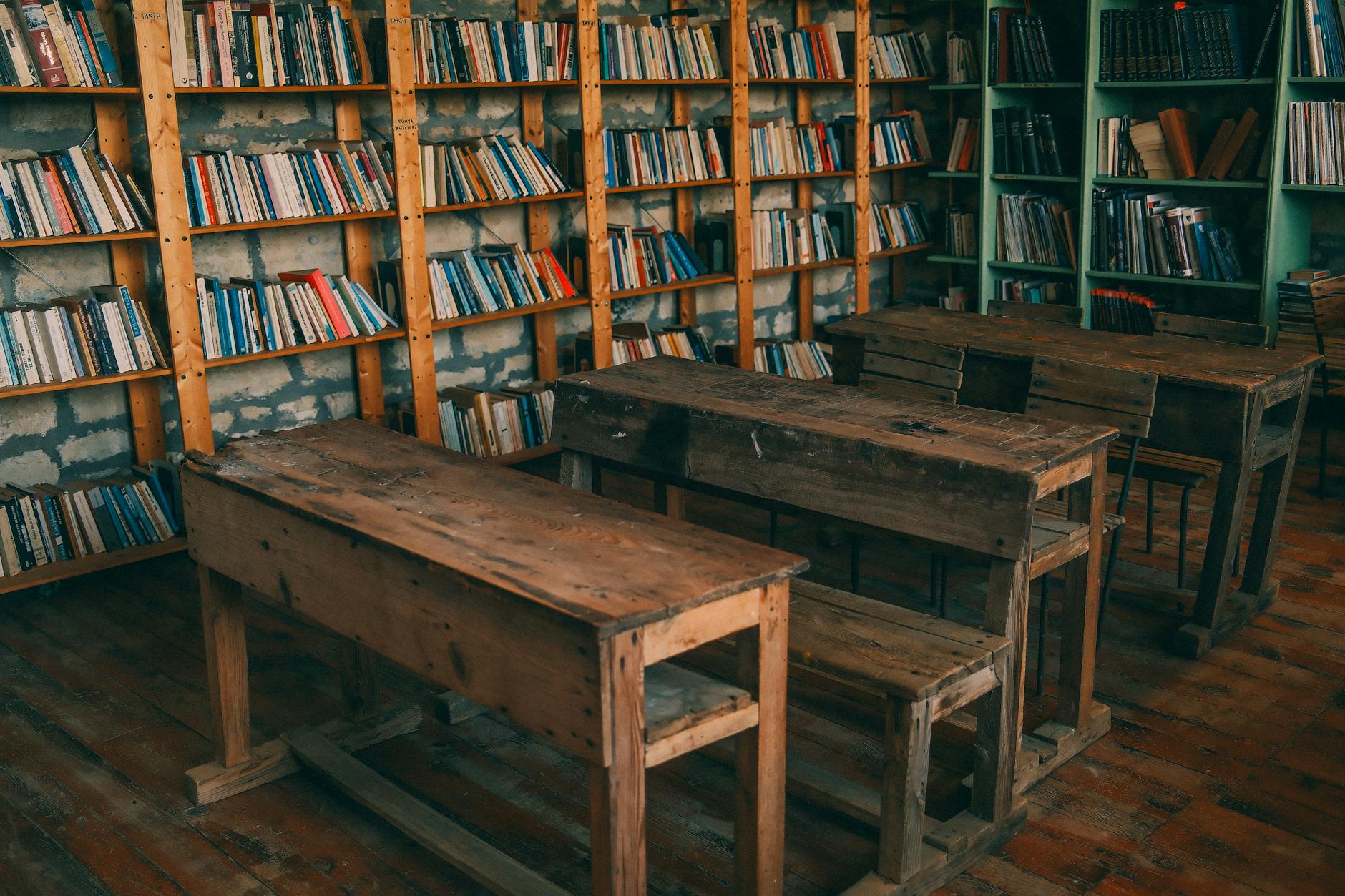
Marx and Engels at the alcove desk
This is the story most visitors come for, and it deserves telling in full.
Friedrich Engels arrived in Manchester in 1842 to work for his father’s textile firm, Ermen & Engels, at the Victoria Mill in Weaste, Salford. He was 22, the son of a wealthy German manufacturer, and a recently radicalised young political journalist. His Manchester experience was transformative — he spent his days running a cotton-thread firm and his evenings observing the working conditions of the city’s mill workers, often guided by his Irish working-class partner Mary Burns through the slums of Ancoats, Little Ireland, and Hulme. His observations became The Condition of the Working Class in England, published in German in 1845 and in English in 1887.
In the summer of 1845, Karl Marx visited Engels in Manchester for several weeks — partly to escape political pressure in Brussels, partly to do research. The two men developed a working routine: every morning they walked to Chetham’s Library, sat at the four-sided desk in the window-alcove of the Reading Room, and read systematically through the library’s holdings on political economy — Adam Smith, David Ricardo, Thomas Malthus, James Mill. The reading fed directly into the work that would become The Communist Manifesto, written and published in 1848.
Engels wrote to Marx in 1870, returning to Chetham’s for old times’ sake:
“During the last few days I have again spent a good deal of time sitting at the four-sided desk in the alcove where we sat together twenty-four years ago. I am very fond of the place. The stained glass window ensures that the weather is always fine there.”
The desk is still there. The alcove is still there. The stained glass was damaged in a winter 1875 storm and replaced with plain glass (the weather is now sometimes less fine), but otherwise the spot is exactly as it was when Marx and Engels worked at it. Facsimile copies of the economics books they studied are laid out on the table today. The guide will show you. Few historical sites in the UK feel this directly continuous with a globally significant moment.
Other notable users and visitors
The library has been used by an extraordinary range of people across 372 years. Verified historical users and visitors include Daniel Defoe (the novelist and journalist), Benjamin Franklin (during his European travels), Benjamin Disraeli (the future Prime Minister), Charles Dickens (a friend of the Manchester novelist William Harrison Ainsworth, who was a regular reader), and contemporary visitors including Damon Albarn of Blur and Gorillaz. The library has been a regular research stop for academics, novelists, and political thinkers since the 17th century.
How to visit Chetham’s Library
You cannot just walk in
This is the single most important practical point: Chetham’s is not a walk-in tourist attraction. Tourist access is by pre-booked guided tour only, because the medieval site is shared with Chetham’s School of Music (a working specialist music school for ages 8–18) and safeguarding plus capacity limits apply. You must book a tour in advance via library.chethams.com or by phone (0161 834 7961).
Booking and prices
Tours can be booked up to 6 weeks in advance. Tour fee: £6.50–£12 per person plus booking fee, depending on tour type. Children under 10 are free with a paying adult but still require a ticket. Minimum age from January 2026: 8 years old (this is a recent change — older guides may not reflect it).
Tour times and length
Tours run Monday to Saturday, subject to school events and private hires (which sometimes book out the site for days at a time, particularly in summer). Standard tour length is 60–75 minutes. Late arrivals are not admitted more than 15 minutes after the tour start time — arrive 5–10 minutes early.
Private tours
The library offers private guided tours for groups of 8–22 people by arrangement with the Visitor Services Coordinator. Useful for U3A groups, school visits, family parties.
Photography
Personal photography is allowed (no flash; no shutter sound; wait for the guide’s briefing on what you can and can’t photograph). Commercial photography requires advance permission.
Accessibility
This is the major caveat. The library buildings are 600 years old, with an 18-step staircase, cobbled yard, no lift, and no disabled toilet. There are also no public toilets on site. Wheelchair users can access the collections as readers (with prior arrangement and accessible-reading-room provision) but cannot join the standard guided tour. The library is upfront about this on the website — please check before booking if you have access needs.
Bags and food
Maximum bag size: 35 × 40 × 19 cm. No food or drink in the historic buildings. The library has no on-site café — the nearest options are around Manchester Cathedral, Victoria station, and the Corn Exchange.
What you’ll see on the tour
The standard guided tour covers:
- The gated book presses — original 17th-century lockable shelving.
- The chained library — historic books still chained to their shelves, as was standard practice in early modern libraries.
- The Marx and Engels desk in the Reading Room window alcove.
- Historic furniture and paintings across the rooms.
- The medieval cat flaps in some of the doors.
- The Cloister Court and Baronial Hall.
- Highlights from the collection (Nuremberg Chronicle, illuminated manuscripts, early printed books — items on display rotate).

The Portico Library — Manchester’s Regency reading room
Manchester’s other major historic library is the Portico Library, founded in 1806 by 400 Manchester subscribers (the idea was hatched at an 1802 meeting of city businessmen inspired by Liverpool’s Athenaeum). The building, on the corner of Mosley Street and Charlotte Street (57 Mosley Street, M2 3HY), was designed by Thomas Harrison in elegant Greek Revival style — “the most refined little building in Manchester.”
The Portico is a subscription/membership library, holding around 25,000 volumes (mostly 19th-century, plus contemporary fiction and non-fiction). Its free public exhibitions, café (The Portico Kitchen) and bookshop are open six days a week beneath a Regency painted-glass dome. Reader access for non-members is via a temporary ticket: £10 per week or £25 per month.
Notable historical members include Peter Mark Roget (the library’s secretary, who wrote his Thesaurus here), John Dalton (the chemist and originator of atomic theory), and Sir Robert Peel (the future Prime Minister and founder of the modern police force). The library was men-only until the Married Women’s Property Act 1870. Contemporary members include Eric Cantona, who has been spotted reading in the Reading Room.
Manchester Central Library — the 20th-century rotunda
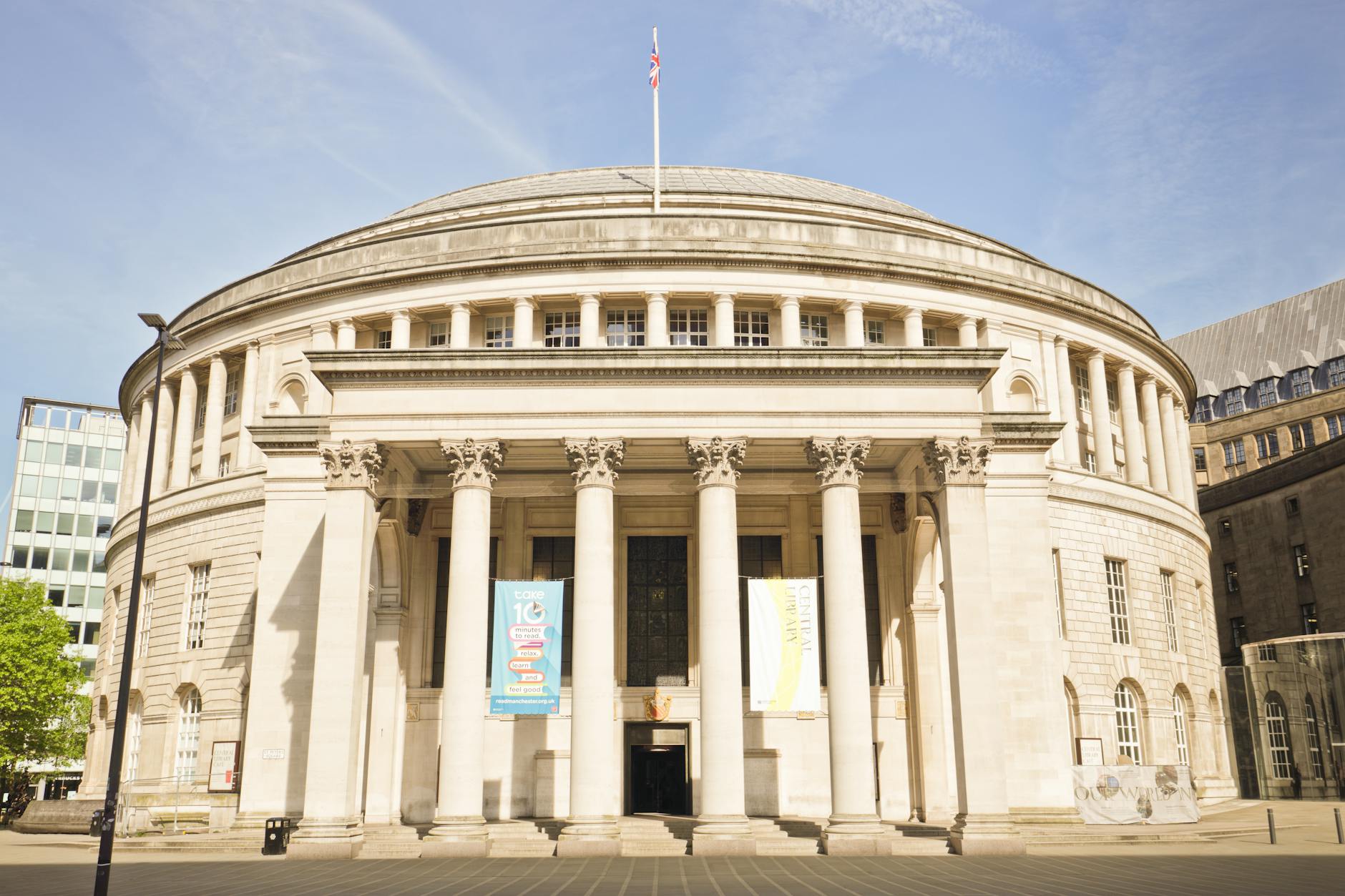
For the third historic library on a Manchester libraries day, head to Manchester Central Library on St Peter’s Square. Built between 1930 and 1934, designed by E. Vincent Harris, opened by King George V on 17 July 1934. The building is a neoclassical rotunda — a circular drum surrounded by Corinthian columns and topped with a copper dome.
The interior centrepiece is the Wolfson Reading Room — a vast circular Great Hall on the first floor, seating up to 300 readers, with green malachite pillars under a wrought-iron clock structure suspended from the dome. The second-largest reading room of its type in the world after the US Library of Congress. Renamed for the Wolfson Foundation following the foundation’s grant during the major 2010–2014 refurbishment.
Manchester Central is a free, public, fully accessible modern library — the counterweight to Chetham’s medieval one. Open Monday–Friday 9am–8pm and weekends 10am–5pm. Architecture students come from across Europe to see the building; locals come to read. Worth a wander.
A “historic libraries” walking itinerary
The three historic libraries fit comfortably into a half-day:
- 10am: Pre-booked Chetham’s Library tour (Long Millgate, M3 1SB). 60–75 minutes.
- 11.30am: Coffee at the Manchester Cathedral café or Mackie Mayor food hall (5 minutes’ walk).
- 12.30pm: Walk south to St Peter’s Square (15 minutes via Cross Street, past the Town Hall).
- 12.45pm: Manchester Central Library — Wolfson Reading Room, the local-history collection, a sit-down in the Great Hall.
- 1.45pm: 5-minute walk east on Mosley Street to the Portico Library.
- 2pm: The Portico — the free exhibitions, the Greek Revival reading room, lunch or coffee in The Portico Kitchen.
- 3.30pm: Optional fourth stop — the John Rylands Library, 10 minutes further west on Deansgate, the Victorian Gothic finale to the day.
Four libraries, four entirely different architectural moods, all walkable, total cost £6.50–£12 (Chetham’s tour) plus £10 if you do a temporary Portico ticket. See our John Rylands guide for the optional fourth stop.
FAQ — Chetham’s Library and historic Manchester libraries
Is Chetham’s Library free?
Reader access for research is free (book by appointment). Tourist visits require a pre-booked guided tour at £6.50–£12 per person.
How do I visit Chetham’s Library?
Book a 60–75 minute guided tour via library.chethams.com or by phone (0161 834 7961), up to 6 weeks in advance. Tours run Monday–Saturday. Minimum age 8 from January 2026.
Where did Marx and Engels meet at Chetham’s?
At the four-sided alcove desk in the Reading Room window, summer 1845. The desk and window survive and are shown on every tour.
What is Chetham’s School?
Chetham’s School of Music — an internationally renowned specialist music school for ages 8–18, founded by the same 1653 Humphrey Chetham bequest as the library. Shares the medieval site but is a separate institution today.
How old is Chetham’s Library?
Founded 1653 (372 years old in 2026). The buildings date to 1421.
What is the oldest library in the UK?
Chetham’s Library — the oldest free public reference library in the English-speaking world. The Bodleian (1602) and other university libraries pre-date Chetham’s but were not free public institutions.
Can I take photos at Chetham’s?
Yes — no flash, no shutter sound, wait for the guide’s briefing. Commercial photography requires advance permission.
Is Chetham’s Library accessible?
Limited. The medieval buildings have an 18-step staircase, cobbled yard, no lift, no disabled toilet, no public toilets. Wheelchair users can access the collections as readers (by prior arrangement) but not the standard guided tour.
Is the Portico Library free?
The free public exhibitions, café and bookshop are open six days a week — no charge. Reader access to the library proper is by membership or temporary ticket (£10 per week or £25 per month).
Where is Manchester Central Library?
St Peter’s Square, Manchester M2 5PD — opposite the Town Hall. Free public library, fully accessible. Open Monday–Friday 9am–8pm.
Who was Humphrey Chetham?
A Manchester textile merchant, banker and landowner (1580–1653), one of the wealthiest men in 17th-century Lancashire, who left his estate to found a free public library and a blue-coat school for poor boys.
What’s the Marx and Engels quote about Chetham’s?
Engels wrote to Marx in 1870: “During the last few days I have again spent a good deal of time sitting at the four-sided desk in the alcove where we sat together twenty-four years ago. I am very fond of the place. The stained glass window ensures that the weather is always fine there.”
Plan more of your Manchester visit
Chetham’s Library combines naturally with Manchester’s other historic libraries and museums. Our John Rylands Library guide covers the Victorian Gothic sister 10 minutes south on Deansgate; our People’s History Museum guide covers the radical history museum 7 minutes west; our free museums in Manchester guide has the wider list. For everything, see our Manchester museums and culture pillar.