This article contains advertising. Our booking links are routed through a partner that adds commission tracking automatically, so if you book through one we earn a commission from the provider, at no extra cost to you. It never affects what we recommend. Affiliate disclosure
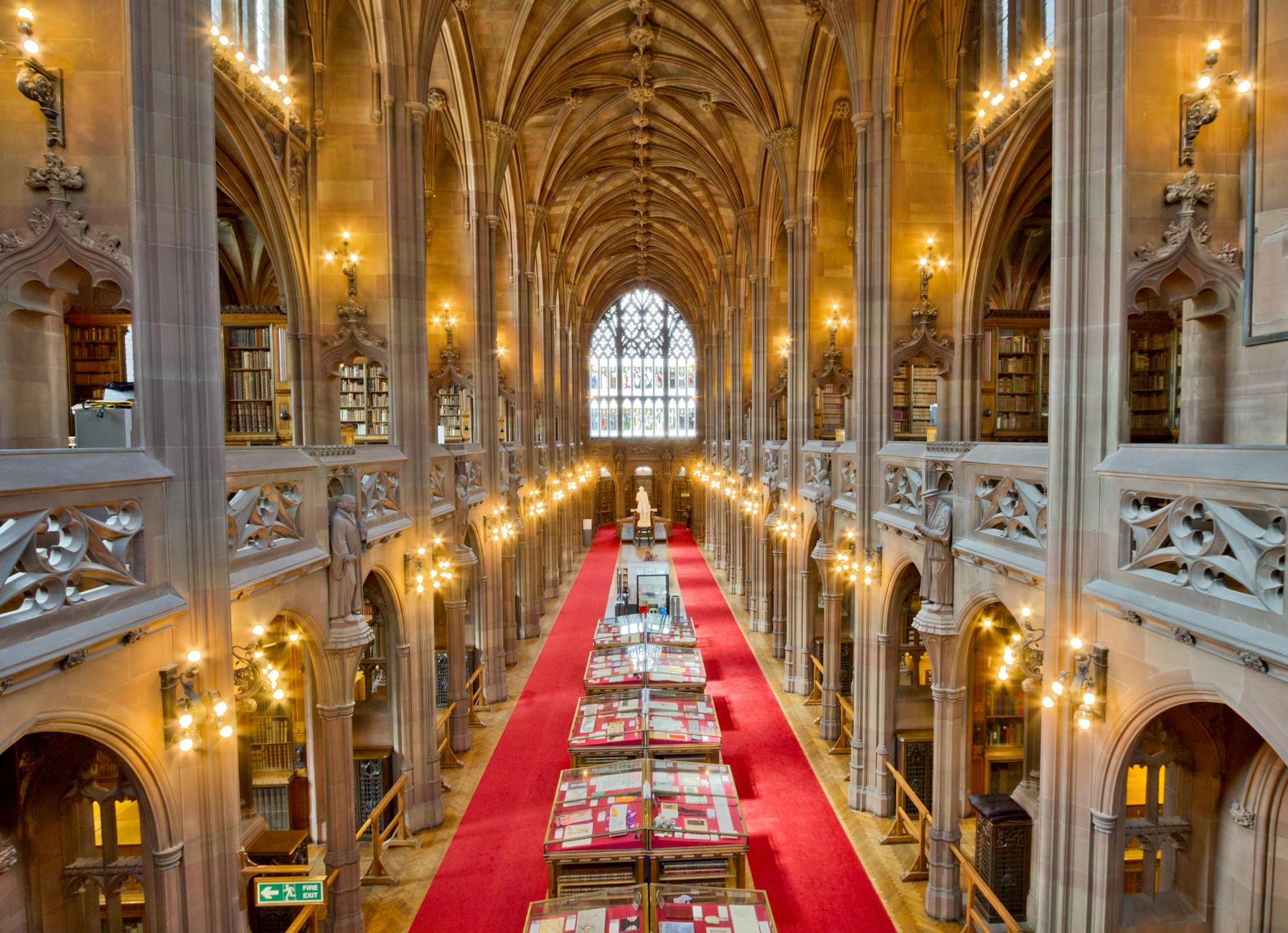
People walk into the John Rylands Library Historic Reading Room and stop talking. They actually stop talking. It happens consistently, regardless of demographic — students, tourists, locals, families with kids. The vaulted Victorian sandstone, the stained glass, the marble statues of Enriqueta and John Rylands at either end, the rows of oak desks under green-shaded lamps — it has the effect of a cathedral on people who have never been in a cathedral. Which is, more or less, what Enriqueta Rylands paid Basil Champneys to build for her in 1899 as a memorial to her late husband.
This is the complete 2026 visitor guide to the John Rylands Library — what to see, the post-refurbishment changes (£7.6m work completed May 2025), the rare books and the Gutenberg Bible, opening hours and how to visit, and the “is it really like Hogwarts” question that brings half the Instagram crowd through the door. Free entry, no booking, 10 minutes from Piccadilly. For wider context see our free museums in Manchester guide and the museums and culture pillar.
John Rylands Library at a glance
- Address: 150 Deansgate, Manchester M3 3EH
- Phone: 0161 306 0555
- Hours: Wednesday–Saturday 10am–5pm (last entry 4.40pm). Closed Sunday, Monday, Tuesday.
- Admission: Free, no booking required. Donations welcome.
- How long: 60–90 minutes for the building and exhibitions; longer if you sit down with a book or attend a tour.
- Closest transport: St Peter’s Square tram (5 min walk), Manchester Oxford Road train (10 min walk), Manchester Piccadilly (15 min walk).
- Owned by: The University of Manchester (since 1972).
The story: Enriqueta Rylands and a memorial built of books
The library was built between 1890 and 1899 by Enriqueta Augustina Rylands, who outlived her cotton-magnate husband John Rylands (1801–1888) and decided his memorial should be a great public library. John Rylands was Manchester’s first multi-millionaire — at his death he owned 17 mills, employed 15,000 people, and was the city’s largest single contributor to Manchester philanthropic causes. He had no interest in books. Enriqueta, his third wife and 38 years his junior, did.
She bought the site on Deansgate in 1889, commissioned the architect Basil Champneys (1842–1935), and oversaw a build that took the best part of a decade. The library was inaugurated on 6 October 1899 — the Rylands’ wedding anniversary — and opened to the public on 1 January 1900. Enriqueta then spent another nine years buying up the great manuscript collections of Europe (most importantly the Spencer collection, the 2nd Earl Spencer’s 41,000-volume library) and depositing them in her library.
She remained librarian and director until her death in 1908. The library joined the University of Manchester in 1972 and operates today as the John Rylands Research Institute and Library.
The architecture: Basil Champneys’ neo-Gothic cathedral of reading
Champneys was a specialist in Gothic Revival college buildings (Oxford’s Mansfield College, Cambridge’s Newnham College, the Indian Institute), but the John Rylands is widely considered his masterpiece. It is built of red Penrith sandstone, the same stone as Manchester Cathedral. The style is Victorian Late Gothic Revival with strong Arts and Crafts detailing.
The exterior is properly cathedral-like — buttresses, pinnacles, tracery, the ornate gatehouse onto Deansgate (preserved to give the impression you are approaching a college quadrangle, not a bookshop). Inside, the vaulted Historic Reading Room is the showpiece — 50 metres long, with paired sandstone columns, ribbed sandstone vaulting, lantern roof, and marble statues of Enriqueta and John facing each other from the alcoves at either end.
The library was Grade I listed in 1994 — the rarest English Heritage listing, given to only the most significant 2.5% of listed buildings.
Inside the Historic Reading Room
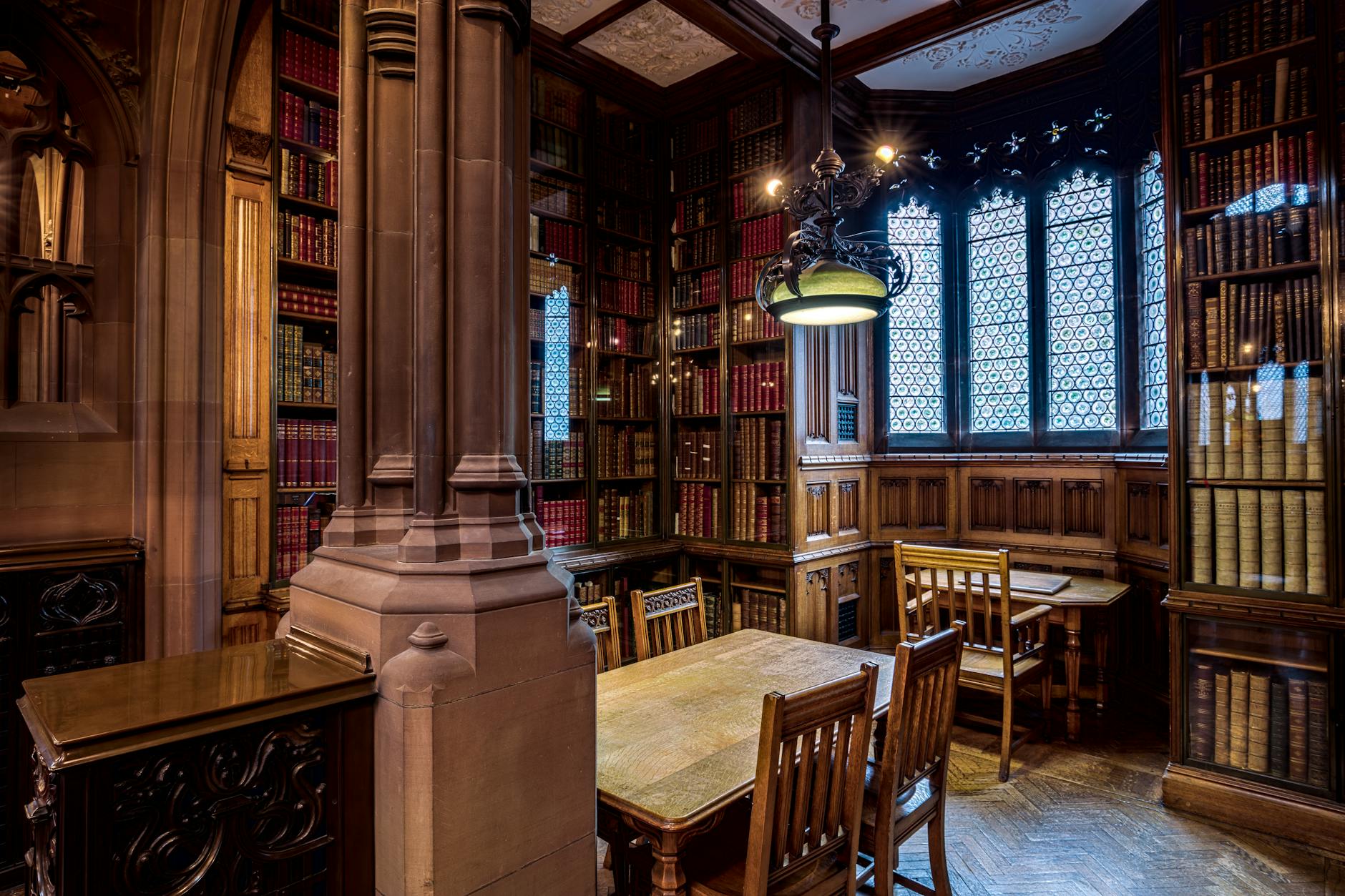
This is what you came for. The Reading Room runs the entire length of the building, with alcoves off the main vault containing tall bookcases of the original Rylands collection. Each alcove was historically reserved for a specific subject — theology, classics, English literature, history. The desks are original oak, the chairs heavy, the lamps brass-and-glass. There are very few rooms in the UK that achieve this combination of religious solemnity and intellectual purpose.
Photography is allowed — but no flash, no tripods, no reflectors. The most-photographed angle is from the bottom of the room looking up the length of the vault towards Enriqueta’s statue, with the lantern roof in full view. Go on a weekday morning for empty desks.
The collections: treasures you can actually see
Beyond the building, the John Rylands holds genuinely one of the world’s great rare-book and manuscript collections. The permanent Collections Gallery rotates display items every few months; key holdings include:
Rylands Library Papyrus P52 — the “St John Fragment”
A scrap of papyrus measuring just 9 × 6.4 cm, containing a few lines of the Gospel of John (chapter 18, verses 31–33 on the front, 37–38 on the back), in Greek, dated to about AD 100–160. Widely cited as the earliest extant fragment of any New Testament text. It came to the library in 1920 in a batch of Egyptian papyri acquired by Bernard Grenfell — its significance was only recognised in 1934 when scholar Colin Roberts identified the script style. On display in the Collections Gallery.
Gutenberg Bible
The library holds a copy of the 42-line Bible printed by Johannes Gutenberg in Mainz around 1455 — the first major book printed using movable type in Europe. There are 48–49 surviving copies; the Rylands’ copy is one of three “perfect” complete copies in the UK. The vellum and paper are in extraordinary condition. Displayed in rotation.
Caxton, Aldine and Spencer
The library holds the second-largest collection of William Caxton books in the world (Caxton was the first English printer, active in the 1470s and 80s — his works are the cornerstone of English printing history). The Aldine Press collection (Renaissance Venice, the great humanist printer Aldus Manutius) is the most extensive anywhere. The Spencer Collection — the 41,000-volume library Enriqueta Rylands bought from the 2nd Earl Spencer in 1892 — remains a core of the institution. Plus the Mainz Psalter (1457), the Crawford collection of Arabic and Persian manuscripts, papers of Elizabeth Gaskell and John Dalton, and a first edition of Joyce’s Ulysses.

The £7.6 million transformation: what’s new after 2024–2025
The library closed sections in February 2024 for a major refurbishment by architects Donald Insall Associates (heritage specialists) with Nissen Richards Studio doing the exhibition design. The work completed in May 2025 and won the FX Award 2025 for interior design.
Key changes you’ll see today:
- New bronze entrance portal — the previous revolving door was replaced with a solid bronze door evoking the pages of a book. Visually striking; mechanically far more accessible.
- Reimagined Collections Gallery — purpose-built, climate-controlled, with state-of-the-art display cases showing the Gutenberg, P52, Caxton and rotating treasures.
- New imaging laboratory for digitisation of the collection.
- Flexible event and teaching space for talks, workshops, school visits.
- New wayfinding throughout the building — much easier to navigate.
- Refurbished shop on the ground floor (card payment only — note this if you want a souvenir).
The Historic Reading Room itself was untouched by the refurbishment — the showpiece is exactly as it was.
Exhibitions and events in 2026
The library runs rotating exhibitions in the Collections Gallery and the Stella Halkyard Reading Room. Current and 2026 exhibitions:
- Cottonopolis: The Origins of Global Manchester — long-running exhibition exploring Manchester’s cotton-trade origins, the global supply chains it created, and the human cost (including American slavery). Free.
- Collections Gallery — permanent rotating display of Rylands’ rarest items (P52, Gutenberg, Caxton, illuminated manuscripts).
- The Forgotten Library — exhibition on overlooked items in the collection.
Regular daily activities (when the library is open):
- Rylands Discovery Tour — 3pm daily, free, 30 minutes, no booking.
- Rare Reads facsimile encounters — 10.40am and 2.10pm, free, see facsimile copies of star items up close.
- Printing Press Demonstration — 11.30am, on an antique Colombian press, free.
Planning your visit: opening hours, tickets and practical info
Opening hours (2026)
Wednesday, Thursday, Friday, Saturday: 10am–5pm (last entry 4.40pm). Closed Sunday, Monday, Tuesday. Closed 22 December 2025 – 6 January 2026 and on selected bank holidays. The Reader Services / Special Collections Research Room operates by appointment Monday–Saturday.
Admission and donations
Free entry, no booking, no ticket needed. The library is supported by the University of Manchester and visitor donations — a £5 contribution at the door makes a meaningful difference.
Photography rules
Personal photography is allowed. No flash, no tripods, no reflectors. Commercial photography requires permission in advance via the library.
What you can take in
No food or drink (bottled water is fine). No suitcases. Children must be accompanied. The shop on the ground floor is card payment only.
Queueing at busy times
The library can develop a queue outside on summer weekends — particularly between 11am and 2pm. Arrive at opening (10am) or after 3pm if you want a quiet visit.
How to get to 150 Deansgate
Walking from main stations
From Manchester Piccadilly, walk west along Piccadilly Approach, through Piccadilly Gardens, along Market Street and Cross Street, down John Dalton Street and into Deansgate — about 15 minutes. From Manchester Oxford Road, north along Oxford Street and St Peter’s Square then west onto Deansgate — about 10 minutes. From Manchester Victoria, south down Cross Street to St Peter’s Square then west — about 12 minutes.
Tram
St Peter’s Square Metrolink is the nearest stop (5 minutes’ walk). Deansgate–Castlefield is about 10 minutes’ walk south. All Manchester tram lines serve St Peter’s Square.
By car and parking
No on-site parking. Use Q-Park Deansgate North, Q-Park Spinningfields, or Q-Park Great Northern — all 5 minutes’ walk. Parking £15–25 for a day.
How long to spend (and a suggested 90-minute itinerary)
30-minute “quick look”
Walk in, Historic Reading Room (15 minutes), Collections Gallery (10 minutes), shop, out. Useful if you’re combining with other Deansgate stops.
60-minute “proper visit”
The above plus the Cottonopolis exhibition and a coffee in the shop foyer.
90-minute “do it justice”
The above plus the 11.30am Printing Press Demonstration or the 3pm Discovery Tour, plus time to sit down with a book in the Reading Room.
Accessibility, families, and group visits
The library has step-free access via the modern entrance, accessible toilets, induction loops, and large-print guides. The Historic Reading Room is on the first floor — a lift is available. Families are welcome; children’s activity sheets are available at the welcome desk; the 11.30am Printing Press Demonstration is brilliant for ages 7+. Group visits (school groups, U3A, community groups) can be booked via the library website with at least three weeks’ notice.
The shop, café options and nearby refreshment
The library has a shop on the ground floor selling postcards, prints, books, greetings cards, and gift items related to the collection. Card payment only. There is no on-site café (a frequent source of negative reviews — please bear this in mind). For coffee and lunch, Deansgate is dense with options: Pollen Bakery on Deansgate is two minutes’ walk; The Refuge at the Kimpton Clocktower hotel is five minutes; the food courts at Spinningfields and the Great Northern Warehouse are both nearby.
Combine your visit: what to see near John Rylands
The library sits in the densest cultural quarter of Manchester. Within a 10-minute walk:
- Manchester Cathedral — 7 minutes north, free, beautiful medieval interior.
- Chetham’s Library — 8 minutes north, the oldest free public library in the English-speaking world, pre-booked guided tours.
- Science and Industry Museum — 10 minutes south-west into Castlefield, free, world’s oldest passenger railway station.
- People’s History Museum — 5 minutes north, free, in Spinningfields.
- Manchester Art Gallery — 5 minutes east, free, Pre-Raphaelite collection.
- Manchester Central Library — 5 minutes east at St Peter’s Square, free, Vincent Harris’s 1934 rotunda.
- Deansgate shopping — the high-street directly outside.

Is John Rylands Library worth visiting? Honest verdict
Yes. It is one of the three or four most striking interior spaces in Manchester, free, easy to fit into a longer city day, and properly substantial as a museum visit even before you get to the collections. The “Hogwarts library” framing is real (the Harry Potter film production team reportedly visited for sketches and measurements pre-production) but undersells what the building actually is — a Victorian act of marital devotion and intellectual ambition, executed at the highest possible level by the best architect Enriqueta Rylands could hire. If you only do one free museum in Manchester, the John Rylands is the romantic choice.
FAQ — John Rylands Library
Is John Rylands Library free?
Yes — admission is free, no booking required. Donations welcome at the door.
How long should I spend at John Rylands?
30 minutes for a quick look, 60–90 minutes for a proper visit, longer if you sit down with a book or attend a tour or demonstration.
What are the opening times?
Wednesday–Saturday 10am–5pm (last entry 4.40pm). Closed Sunday, Monday, Tuesday.
What is there to see at John Rylands?
The Historic Reading Room (the famous Victorian neo-Gothic vault), the Collections Gallery (rotating display of the Rylands Papyrus P52, the Gutenberg Bible, Caxton books and illuminated manuscripts), the Cottonopolis exhibition, the Printing Press Demonstration, and the Bronze Door entrance.
Is John Rylands Library worth visiting?
Yes — consistently rated among Manchester’s best free attractions. The Historic Reading Room is one of the most photographed library interiors in the world.
Is it really like the Hogwarts library?
Harry Potter producers reportedly visited pre-production for sketches and inspiration. The reading room has the “Hogwarts” aesthetic — Victorian Gothic, vaulted, stained glass, oak desks under green lamps.
Can I take photos?
Yes — no flash, no tripods, no reflectors. Personal use only; commercial photography requires advance permission.
Is there a café at John Rylands?
No on-site café. The shop is card-only. For coffee, Deansgate has plenty of options two minutes’ walk away.
Is John Rylands wheelchair-accessible?
Yes — step-free entry via the modern entrance, lift to the first-floor Historic Reading Room, accessible toilets, induction loops.
How do I get to John Rylands Library?
150 Deansgate, M3 3EH — 5 minutes’ walk from St Peter’s Square tram, 10 minutes from Oxford Road station, 15 minutes from Piccadilly. No on-site parking; nearby Q-Park options.
Can I see the Gutenberg Bible?
Yes — when on display in the Collections Gallery. Rotates with other rare items; check the library website for current displays.
What is the Rylands Papyrus P52?
A small fragment of the Gospel of John, in Greek, dated about AD 100–160 — widely cited as the earliest known fragment of the New Testament. Displayed in the Collections Gallery.
Plan more of your Manchester visit
If you’ve enjoyed John Rylands, the rest of Manchester’s museum scene is brilliant. Our Chetham’s Library and historic libraries guide covers the 1653 sister institution 10 minutes north; our Manchester art galleries guide covers Manchester Art Gallery and the Whitworth; our Manchester Museum guide covers the European Museum of the Year 2025; our free museums in Manchester guide has the wider list. For everything, see our Manchester museums and culture pillar.